




10 Essential Facts You Should Know About the Silk Road in China
The Silk Road in China is more than an ancient trade route — it is a legendary corridor that connected Eastern and Western civilizations, shaping the flow of goods, ideas, religions, and cultures across continents. Along this historic passage lie magnificent ancient cities, breathtaking landscapes, and the cultural foundations that still define China’s northwest today.
Are you ready to begin your luxury train journey along China’s Silk Road? Before you set off on this mysterious and storied path, we’ve gathered 10 essential and fascinating facts to help you better understand the depth, history, and hidden charm of this iconic route.
1. The Origins of the Silk Road Predate the Name "Silk Road" by Centuries
The origins of the Silk Road can be traced back to the Western Han Dynasty. At that time, early exchanges between the Central Plains and the Western Regions gradually took shape. Although the term "Silk Road" was coined in the 19th century by the German geographer Ferdinand von Richthofen, the actual cultural and trade networks had existed for centuries before that.
In the context of Chinese history, these routes were far more than trade channels; they also served as diplomatic bridges, military arteries, and conduits for cultural dissemination, allowing knowledge, religions, and artistic traditions to flow between East and West.
Highlights:
● The earliest record of long-distance diplomacy is Zhang Qian's mission to the Western Regions (138–126 BCE).
● Silk, jade, fine horses, and metal artifacts were among the most influential early commodities.
● Many routes overlapped with ancient nomadic migration paths and imperial military defenses.

2. The Silk Road in China Spans Extremely Diverse Natural Landscapes
Within China alone, the Silk Road stretches about 4,000 kilometers, traversing the Loess Plateau, Qilian Mountains, Gobi Desert, basins, and numerous oasis towns. This immense geographical diversity makes the Chinese section one of the most culturally rich and strategically significant parts of the entire Silk Road network.
Highlights:
● Diverse ecosystems influenced settlement patterns and shaped oasis-centered urban cultures.
● Dynasties such as Han, Tang, and Tubo invested heavily in maintaining transportation security.
● Caravans would switch pack animals based on terrain: horses for plateaus, camels for deserts.
3. The Silk Road in China Was Never a Single Line, But a Multi-Layered Interwoven Network
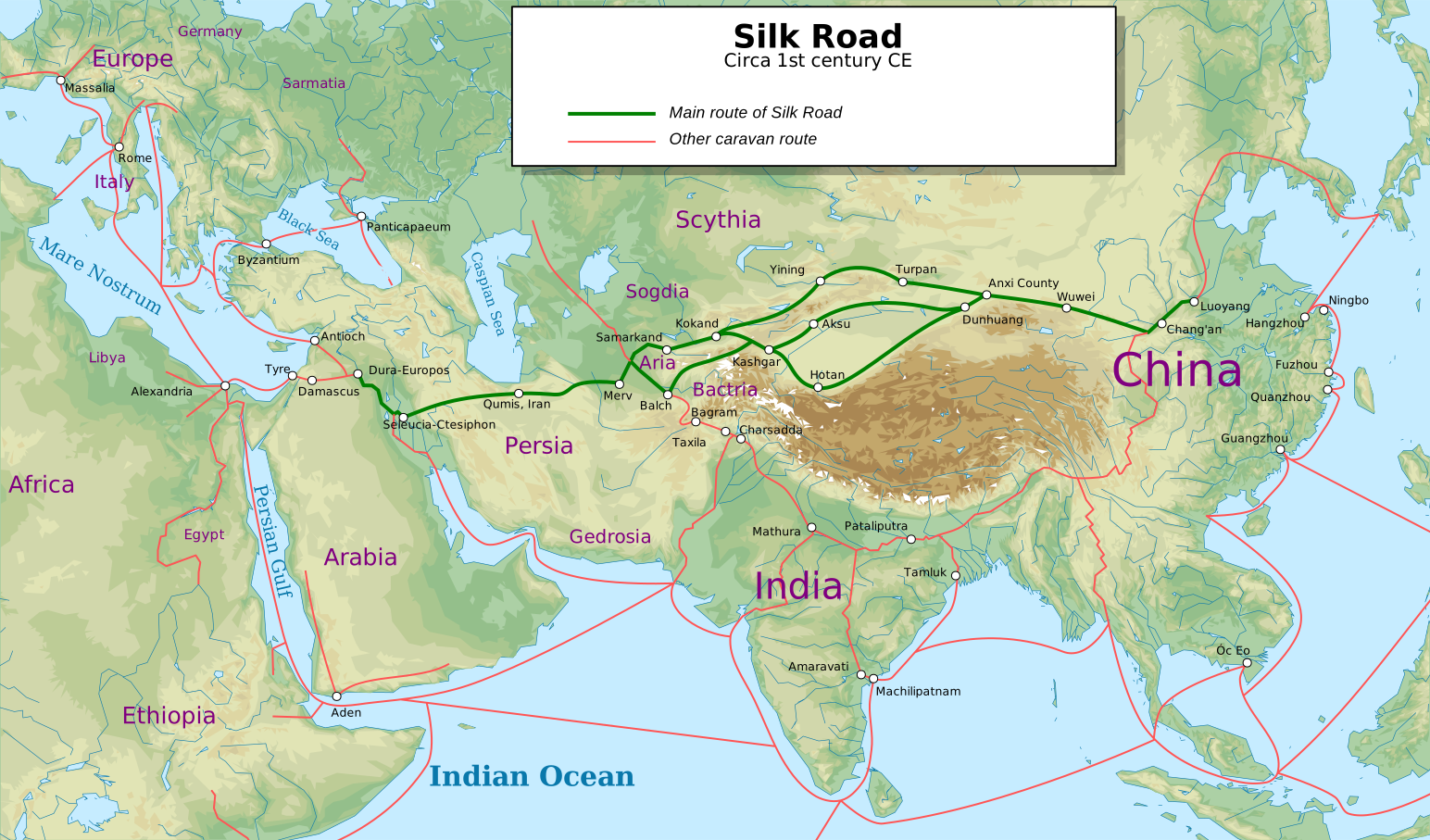
The Silk Road was not a straight corridor but a set of overlapping paths: the Northern Route, Middle Route, and Southern Route. Each route would adjust based on seasons, supply points, and political situations.
This network structure ensured that even if one segment was unsafe, trade and exchanges could continue through other routes.
Main components of the network:
● Northern Route: Distributed along the northern foothills of the Tianshan Mountains
● Middle Route: Linking oases along the eastern edge of the Tarim Basin
● Southern Route: Circling the southern edge of the Taklamakan Desert
● Mountain passes and river valleys served as natural "gateways"
4. The Silk Road Brought More Than Trade; It Profoundly Changed China's Religion, Art, and Science
The Silk Road facilitated large-scale cultural fusion. Buddhism entered China along these routes, bringing artistic styles, musical traditions, agricultural knowledge, and astronomical calendar studies.
This flow of ideas particularly shaped the multi-ethnic, multi-lingual, and multi-traditional cultures in Gansu and Xinjiang regions.
Examples of cultural exchanges:
● Large Buddhist ure translation centers formed in the west
● Western musical modes influenced ancient court music
● Murals show elements of Persian, Hellenistic, and Central Asian styles
5. Xinjiang Is the Geographic Core of China's Silk Road
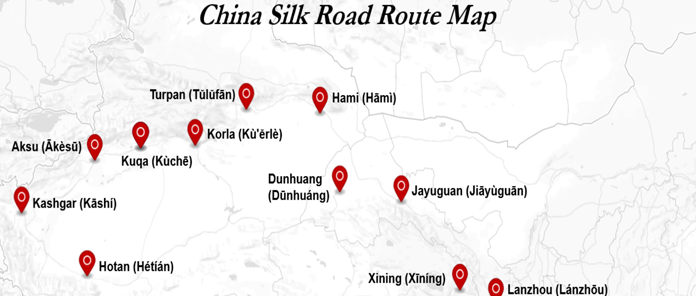
In the map of China's Silk Road, Xinjiang occupies an absolute central position. Basins, mountain passes, and oasis towns together form vital links connecting China with Central Asian nomadic cultures and agrarian civilizations.
Cities like Kuqa, Turpan, Hotan, and Kashgar were hubs for goods, religions, languages, and technologies.
Starting from Xining in Qinghai Province today, ancient travelers would enter the vast corridor leading to the Western Regions from the eastern edge of the Qinghai-Tibet Plateau.
Overview of Xinjiang's importance:
● It was the location of ancient kingdoms like Kucha and Loulan
● The oasis system around the Tarim Basin was a lifeline
● Mountain pass areas were strategic gateways connecting East and West

6. Winter on the Silk Road: Snow-Covered Dunes at Mingsha Mountain and Crescent Spring
The area around Mingsha Mountain and Crescent Spring is one of the most surprising seasonal landscapes on the Silk Road. In winter, a thin layer of snow covers the golden dunes, transforming the desert into a silent white world. Curved sand ridges, frost-dyed shrubs, and deep blue winter skies create a unique scene.
Historically, this oasis was crucial for caravans crossing the desert. The "singing sand" phenomenon at Mingsha Mountain, the stable water source at Crescent Spring, and the shelter of surrounding cliffs made it an important navigation and supply point.
Additional information:
● The "singing" of Mingsha Mountain comes from natural resonance caused by friction in the sand layers.
● The shape and water volume of Crescent Spring are maintained long-term by underground springs.
● This site is directly connected to Dunhuang's status as a cultural and commercial hub.

7. China's Silk Road Is Dotted with Ancient Ruins—Many Hidden Deep in the Desert Interior
In the western section of the Silk Road, numerous ancient cities, temples, fortresses, and beacon towers lie scattered, buried by time and sandstorms. They are like chapters sleeping in the depths of the Gobi, recording histories of trade, religion, military affairs, and multi-ethnic exchanges.
One of the most representative sites is the ancient city of Miran, located on the edge of the Taklamakan Desert. This site is famous for its Buddhist stupas, temple murals, and remnants of ancient military and administrative structures, serving as an important node for East-West cultural exchanges.
Ruoqiang: Gateway to Miran Ancient City and a Key Archaeological Hub
Miran Ancient City falls under the administrative area of Ruoqiang County in Xinjiang's Bayingolin Mongol Autonomous Prefecture. Ruoqiang is one of the most critical hubs on the southern line of the Silk Road, known as the "gateway through the Taklamakan." It is not only an important starting point for routes to Loulan and Miran but also a convergence point for multiple ancient trade paths.
The Ruoqiang region boasts dense archaeological remains: ancient beacon towers, pottery inions, Buddhist temple ruins, and tomb clusters scattered across the desert. Due to minimal wind erosion and extreme dryness, many sites are exceptionally well-preserved, making this one of China's most important areas for Western Regions archaeology.
Since Miran Ancient City is within Ruoqiang's jurisdiction, visits to the Miran ruins today must start from Ruoqiang. The area is quiet and vast, with the desert's silence intertwining with the solemnity of the ancient sites, creating a unique sense of "time standing still."
Other major sites include:
● Loulan Ancient City: Mysterious ruins of an ancient Western Regions kingdom, once a transportation center on the southern route.
● Jiaohe Ancient City: The world's largest and best-preserved "rammed earth three-dimensional ancient city," built on a cliff plateau between two rivers.
● Gaochang Ancient City: Where the Tang Dynasty monk Xuanzang once stayed and lectured, serving as a center for Buddhism and trade.
● Han and Tang Desert Beacon Tower Groups: Distributed in areas like Ruoqiang, Qiemo, and Minfeng, these were key military communication networks for the Han and Tang empires' governance of the Western Regions.

8. Sacred Art Corridor: Religious and Artistic Heritage Along the Silk Road
Before introducing specific attractions, one must see the big picture: The Silk Road nurtured one of the world's most glorious belts of religious art. Over a thousand years, monks, painters, translators, and travelers built temples, carved grottoes, and created murals here, turning the region into a corridor of stylistic fusion.
Ta'er Temple: Religious and Artistic Center on the Plateau Edge
Ta'er Temple, located near Xining on the eastern edge of the Qinghai-Tibet Plateau, is famous for its butter sculptures, appliqué embroideries, and murals. It is an important monastery of Tibetan Buddhism and a treasure trove of art. Walking through it feels like stepping into a layered world of colors and rituals. Its architectural style blends Han and Tibetan cultures, making it a key site for understanding the spiritual world of the Silk Road.

Mogao Grottoes: A Desert Library of Human Art
The Mogao Grottoes, south of Dunhuang, are hailed as the "encyclopedia of human visual civilization." Over more than 1,000 years, monks and artisans excavated, painted, and sculpted here, leaving over 2,000 colored statues and 45,000 square meters of murals. It is not only an art treasury but also one of the most important cultural archives in human history.

"Thousand Buddha Caves" Across Regions: Echoes of Faith on the Desert Edge
From the Kizil thousand-Buddha caves in Kuqa, Xinjiang, to various Thousand Buddha Caves in Gansu, these grotto complexes exhibit distinct Kucha and Central Asian artistic styles. Every mural in the caves records moments where faith, art, and travel intersect.

9. The Silk Road Gave Rise to a "Cross-Civilization Translation Network"
During the heyday of the Silk Road, languages between Central Asian and Western Regions cities were so diverse that it was almost like "changing cities meant changing alphabets." To keep trade, religion, and diplomacy functioning, a unique phenomenon emerged—multilingual usage and a cross-civilization translation system.
Ancient Western Regions merchants, monks, and envoys often mastered multiple languages simultaneously:
● Chinese
● Sogdian
● Tocharian
● Syriac
● Even Greek appeared in documents
In some sites, documents were found with more than three languages on the same piece, which was extremely rare elsewhere in the world at the time.
A typical example: Kuqa (Kucha) and the Multilingual Manu Centers
Kucha monks often needed to translate Buddhist ures from Sanskrit to Tocharian, then to Chinese, and finally bring them to Chang'an or Luoyang. Thus, in Kuqa's monasteries, archaeology has uncovered numerous translation notes, proofreading marks, and language comparison tables, resembling an ancient version of a "United Nations translation center."
The Silk Road was therefore not only a trade route but also the world's earliest large-scale cross-language collaboration network.
10. China’s Silk Road Is Home to Some of the Rarest Natural Landscapes on Earth
Beyond ancient cities and Buddhist art, the Silk Road corridor holds some of the planet’s most unusual natural formations—places shaped by plateaus, deserts, salt basins, and powerful geological forces. These landscapes influenced ancient travel routes just as much as trade and politics did.
Qinghai Lake: A High-Altitude Stage of Light and Color
China’s largest saltwater lake almost behaves like a living canvas. Its turquoise surface reflects drifting clouds, distant snow peaks, and vast alpine grasslands. For travelers departing Xining in ancient times, Qinghai Lake marked the symbolic gateway between the heartland and the long road toward the Western Regions.
Qarhan Salt Lake: A Mirror World in the Qaidam Basin
Qarhan Salt Lake, formed by extreme evaporation across millennia, creates a surreal mineral landscape. In the right season, the lake turns into a mirror so clear that sky and earth dissolve into each other.
Its honeycomb salt-crystal fields and sapphire-blue brine pools make it one of the most extraordinary natural formations along the greater Silk Road region.
Zhangye Danxia Landform
The Rainbow Mountains In Gansu Province, the Zhangye Danxia Geopark features stunning multicolored rock formations resembling a palette of reds, yellows, and oranges. These layered sedimentary rocks, eroded over millions of years, provided a vivid backdrop for Silk Road passages through the Hexi Corridor.
Highlights:
● Vibrant stripes created by mineral deposits
● Dramatic hills and valleys best viewed at sunset
● UNESCO-listed geological wonder attracting photographers worldwide
Taklamakan Desert: The Vast Sea of Death
The Taklamakan Desert, one of the world's largest shifting sand deserts, posed a deadly challenge to Silk Road traders who navigated its perilous edges. Known as the "Sea of Death," its endless dunes and extreme aridity shaped alternative routes through surrounding oases and mountains.
Highlights:
● Towering sand dunes reaching up to 300 meters
● Extreme temperature swings from scorching days to freezing nights
● Buried ancient cities and archaeological treasures occasionally revealed by winds
How to Plan a Silk Road Trip in China
1. Luxury Train Journey
If you want a relaxing, worry-free way to explore the Silk Road, a luxury train journey is the best choice. You can enjoy comfortable cabins, scenic observation cars, attentive onboard service, and cultural lectures as you travel across Qinghai, Gansu, and Xinjiang.
2. Guided Group Tour
For first-time visitors who want deeper cultural insights, joining a guided tour is an excellent option. A professional tour leader will take you to iconic destinations such as the Mogao Caves in Dunhuang, Turpan’s ancient ruins, and the Zhangye Danxia landforms. Transportation, hotels, and meals are all arranged, making the journey smooth and efficient.
3. Independent Travel
If you prefer flexibility and a personalized pace, independent travel may suit you best. By combining high-speed rail, self-driving, and local transfers, you can craft your own itinerary to explore ancient cities, desert highways, and hidden natural landscapes along the Silk Road.
Explore the Silk Road with the Silk Road Express
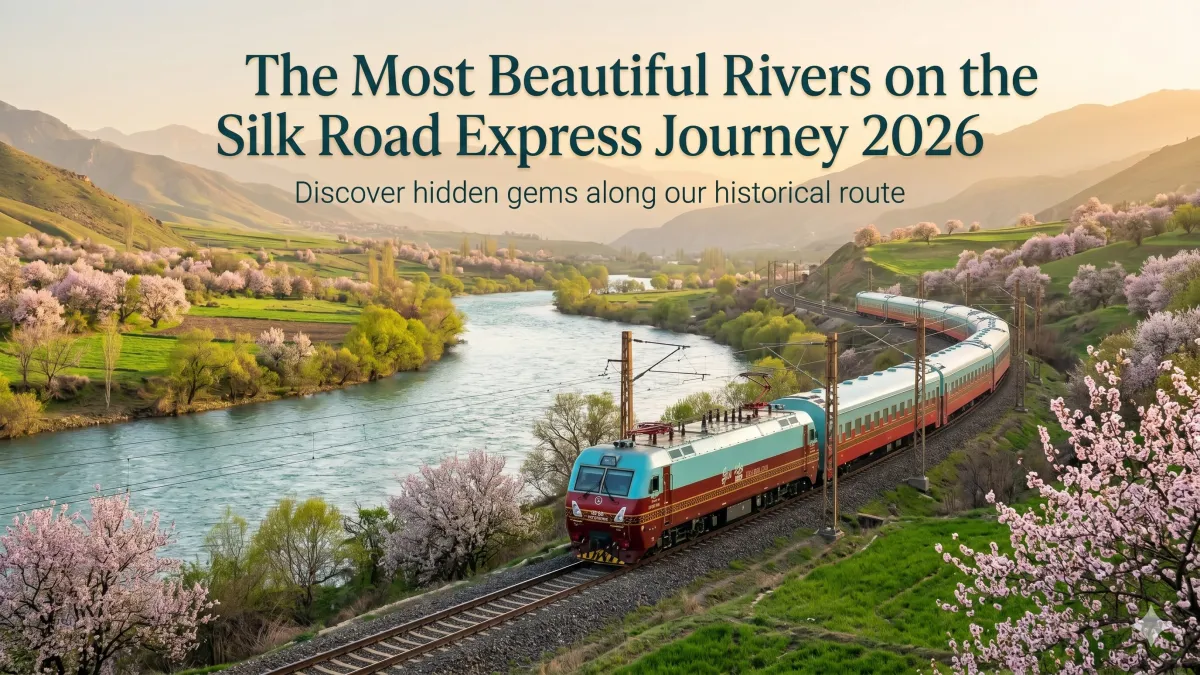
The Silk Road Express is a premium rail experience designed specifically for travelers who want comfort, culture, and convenience along the legendary Silk Road. The train features spacious suites, an observation corridor, a dining car, a lounge car, and full onboard hospitality throughout the trip. Covering major highlights such as Dunhuang, Kuqa(Kuche) and Xining, the route combines immersive sightseeing with professional guides and high-quality dining.
If you’d like to check departure dates, cabin availability, or directly book your journey on the Silk Road Express, feel free to contact our team anytime. We look forward to welcoming you onboard for an unforgettable journey across a thousand years of history.