




What Is a Hami Melon? Taste, Origin, and Why Hami Is Worth Experiencing in Person
If you have recently spotted a Hami melon at a specialty market or grocery store, you are in good company. Interest in this fruit has grown well beyond China, and the reasons are not hard to understand: Hami melon is exceptionally sweet, refreshingly crisp, and widely regarded as a firmer, more intensely flavored alternative to cantaloupe. But while many people first encounter it as a piece of produce, the story of Hami melon begins with a place — Hami, an oasis city in eastern Xinjiang whose name has been tied to this melon for generations.
That connection matters. A Hami melon is not just a generic melon given an exotic label; it is a fruit with a strong regional identity rooted in the climate, geography, and agricultural tradition of Xinjiang. To understand why it stands out on the shelf and on the table, it helps to start with the fruit itself — and then follow its name back to the city that gave it meaning.
What Is a Hami Melon?
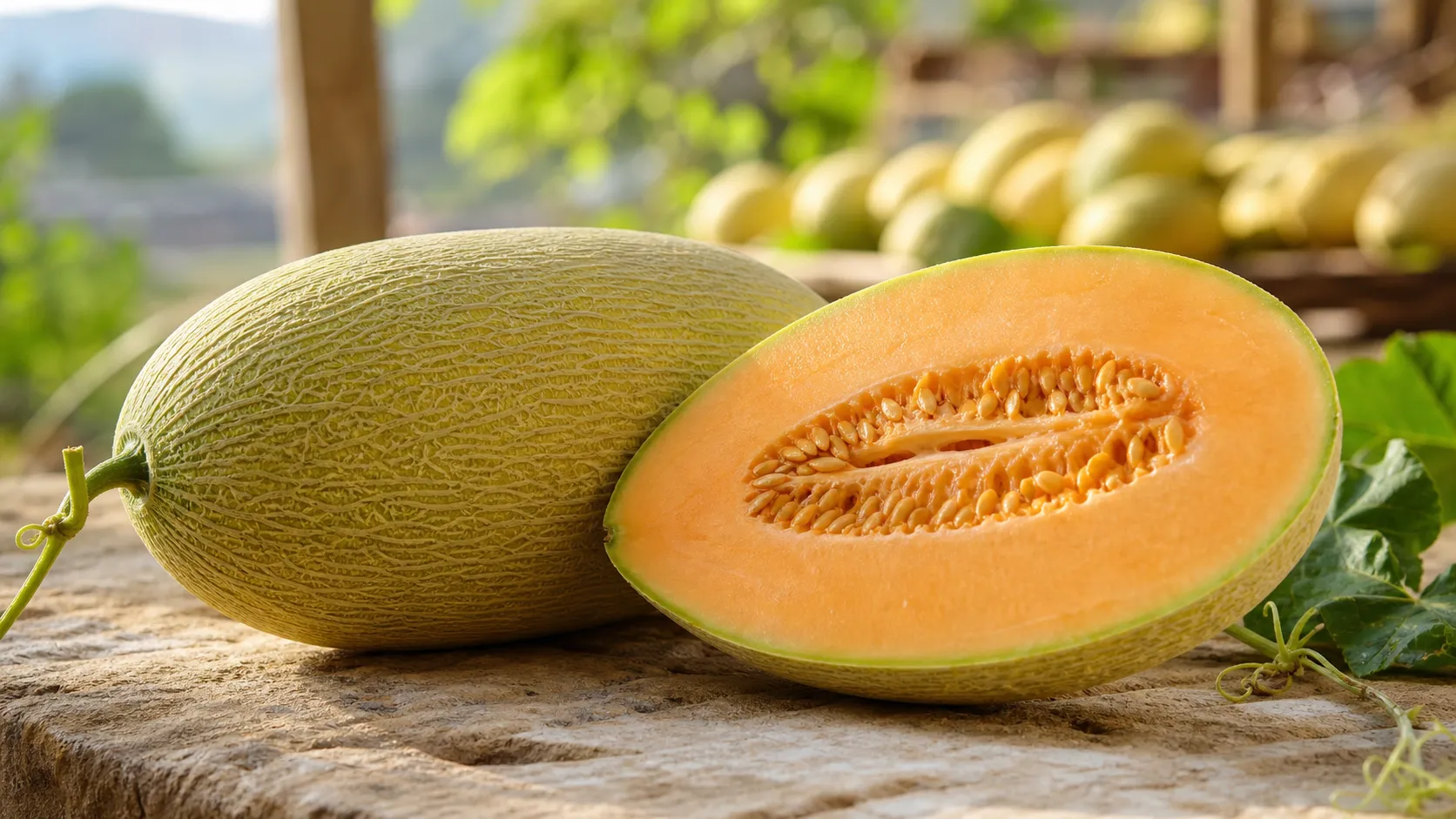 Hami melon is an umbrella term used for sweet muskmelon varieties from Xinjiang, China, with a particular association with the Hami region. It belongs to the muskmelon family (Cucumis melo), and depending on the specific variety, the rind may be pale yellow, cream, green, or lightly netted, while the flesh ranges from white to a soft orange.
In shape, Hami melons tend to be more elongated and oblong than the rounder melons most shoppers are used to seeing. Their identity is also more origin-driven: the name itself points back to Hami, a region long associated with exceptional fruit cultivation and melon quality. Researchers studying genetic diversity among Hami melon varieties have noted the depth of this regional tradition, which spans multiple cultivated varieties and growing conditions.
In simple terms, if cantaloupe is the familiar reference point, Hami melon can be understood as a sweeter, crisper, and more origin-specific cousin — one where the name and the flavor genuinely belong to the same story.
What Does Hami Melon Taste Like?
The most consistent deion of Hami melon across markets and produce guides is straightforward: it is sweet, juicy, and noticeably crisp. Many tasters compare it to cantaloupe but find it firmer and more intensely sweet, with a cleaner finish and a less musky aftertaste.
Part of its distinctiveness is texture. While many melons become soft quickly as they ripen, Hami melon often maintains a pleasantly dense, almost crunchy quality even at peak sweetness — a trait specialty produce sources attributes to its particular growing conditions. That texture makes it especially refreshing when served cold, and especially appealing to people who find softer melons too yielding.
Some varieties carry a lightly floral or honeyed quality alongside the sweetness, though flavor does vary by cultivar and ripeness. For practical guidance: if you enjoy cantaloupe but wish it were sweeter, firmer, and crisper, Hami melon is likely the one you have been looking for.
Hami Melon vs Cantaloupe
Because Hami melon is so often encountered alongside cantaloupe — and because the two are genuinely related — the comparison is worth addressing directly.
Feature | Hami Melon | Cantaloupe |
Shape | Usually oblong | Usually round |
Texture | Crisp and firm | Softer when ripe |
Sweetness | Often perceived as sweeter | Generally milder |
Aroma | Lighter, sometimes floral | More pronounced musk |
Origin identity | Strongly tied to Hami, Xinjiang | Generic market melon |
As A-Z Animals notes in its Hami melon comparison, the two fruits come from the same muskmelon family but diverged through different agricultural traditions. For most shoppers, the clearest difference is the eating experience: Hami melon tends to feel more structured and more refreshing, while cantaloupe is softer and more familiar. The medical and wellness community has also picked up on the distinction, with some food writers emphasizing that Hami melon is not cantaloupe in flavor profile, origin, or character.
How to Tell If a Hami Melon Is Ripe
One of the most common questions buyers ask is how to choose a good one. A few simple checks make a real difference.
● Smell it first. A ripe Hami melon should have a sweet, noticeable fragrance near the stem end. If it has no aroma, it is not ready.
● Pick it up. It should feel heavy for its size, which generally indicates good hydration and flesh density.
● Apply light pressure. It should yield slightly but not feel soft or mushy. Rock-hard means under-ripe; overly soft means past its peak.
● Check the stem area. As the melon matures, the attachment point around the stem often looks drier or more finished. Extension horticulturalists recommend watching for these signs alongside aroma when judging readiness.
● When in doubt, wait. If the melon feels firm and barely fragrant, leaving it at room temperature for a day or two usually brings it to a better stage before chilling.
How to Cut, Eat, and Store Hami Melon
Preparation is simple. Wash the rind thoroughly, cut the melon lengthwise, scoop out the seeds, and slice the flesh into wedges or cubes. The simplest way to enjoy Hami melon is also the most honest: chilled, fresh, and unadorned.
That said, it works well beyond a plain fruit bowl. Because of its firmer texture, Hami melon holds up particularly well in composed salads and cold plates. It pairs naturally with lime, fresh herbs, cucumber, and ginger. For a more indulgent combination, it works beautifully alongside cured meats, salty cheese, or pomegranate — a pairing explored in recipes from The Salted Potato and Most Hungry.
For storage: keep a whole, uncut Hami melon at room temperature until fully ripe. Once cut, wrap it well and refrigerate, and aim to consume it within three to five days for the best quality.
Hami Melon Nutrition and Health Benefits
Like most melons, Hami melon is valued as a hydrating fruit with high water content and relatively modest calories. It is generally recognized as a source of vitamins A and C, along with potassium and dietary fiber — nutrients that support immune function, hydration, and general wellness.
That said, the strongest reason people return to Hami melon is rarely a nutrition label. It is the combination of sweetness, crunch, and refreshment that makes it memorable, especially in warmer months. The nutrition supports the experience; the experience brings people back.
Why Is It Called Hami Melon?
This is where the fruit begins to open into a larger story. Hami melon takes its name from Hami (哈密), a city and prefecture in eastern Xinjiang. The name is not marketing; it reflects a genuine, long-standing connection between the fruit and the region.
Agricultural sources consistently associate Hami melon with the Hami and Turpan basins, where the climate — intense sunshine, large temperature swings between day and night, low humidity, and alkaline desert soils — creates the conditions under which the melon’s sweetness and crisp texture develop most fully. As one Xinjiang produce specialist puts it, the Hami and Turpan basins produce melons with flesh that is thick, sweet, and particularly suited to longer transport and storage.
In other words, “Hami melon” is not just a variety name. It is an origin statement. And once you understand that, the next question almost asks itself: what kind of place produces a fruit this distinctive?
Where Is Hami?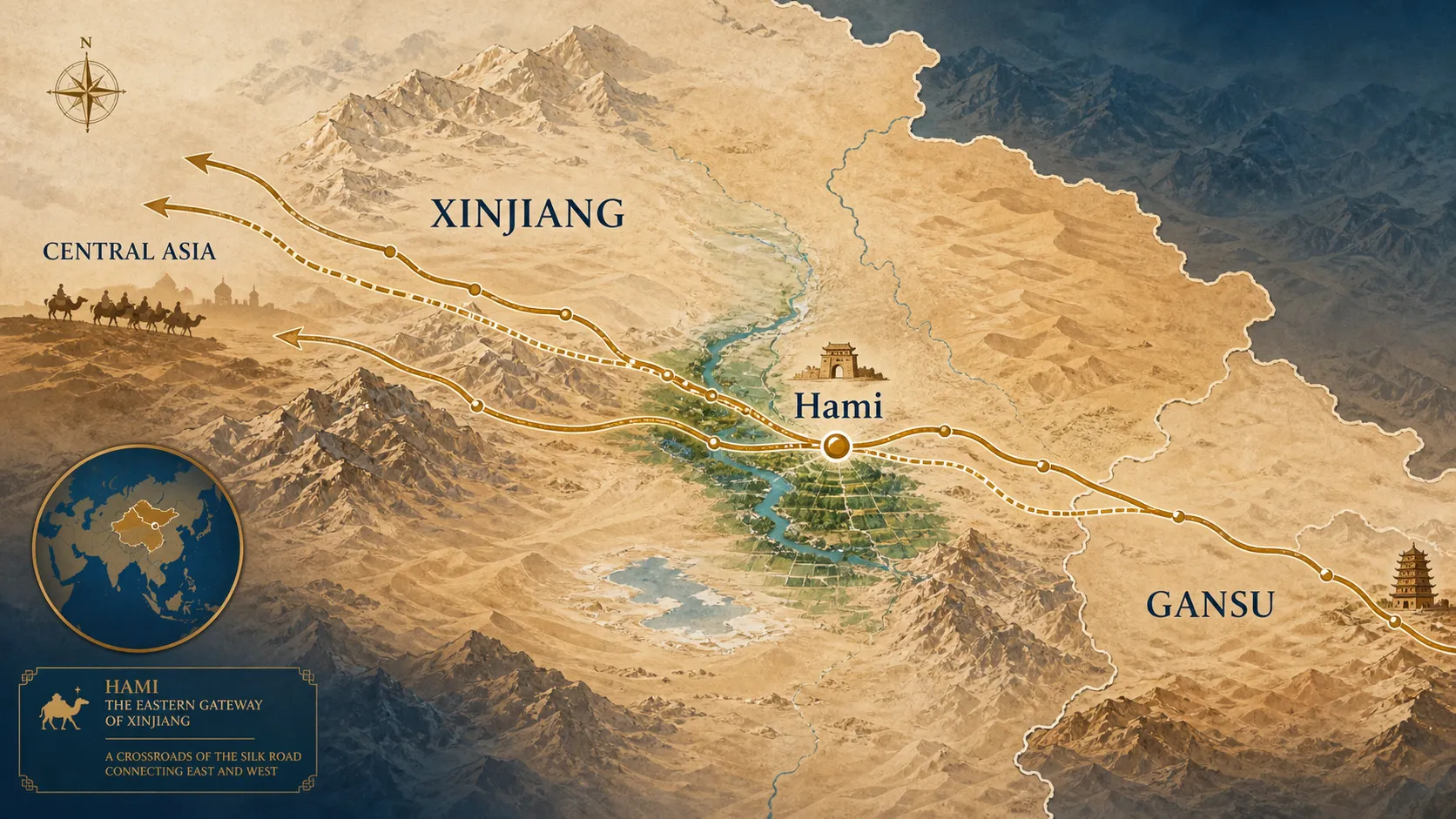
Hami is an oasis city in eastern Xinjiang, located at a geographic crossroads that has shaped its identity for centuries. Historically, it was one of the key passage points between inland China and the Western Regions — the area encompassing Central Asia and beyond — which positioned it as an important Silk Road gateway.
As China Daily describes it, Hami was an unavoidable pass on the Silk Road for travelers and traders moving from the Chinese interior toward the Western Regions. Other cultural and travel sources describe it as the eastern gate of Xinjiang: the point where the vast desert interior of Central Asia begins to open up, and where many Silk Road journeys truly began. That language is evocative and accurate — Hami has long been a threshold place, a city that marks the beginning of something larger.
Hami Beyond the Melon: Culture, Oasis Life, and Silk Road History
Hami is not only known for its fruit. It is a city shaped by oasis life, centuries of frontier exchange, and cultural layers that reflect its position between worlds. Because of its strategic location, Hami developed under the combined influence of Uyghur Muslim culture and Han Chinese culture, forming a local identity that carries the memory of both.
The Asia Cultural Travel guide to Hami describes the city as holding significant cultural and historical depth connected to its Silk Road position — a place where travelers and traders from different directions once rested, traded, and moved on. That history is still present in the city’s character today.
This layered identity gives Hami something that is relatively rare in travel destinations: it is both approachable and genuinely deep. The melon is the approachable surface. The history and culture are what wait underneath.
Hami's Landscapes: From Melon Fields to Yardang Formations
Hami's appeal becomes especially distinctive when you look beyond the oasis to the surrounding landscape. The region is also known for dramatic yardang formations — wind-carved geological features shaped by erosion across vast areas of arid desert.
People's Daily has described Hami's yardang area as among the most heavily concentrated in China. More broadly, Xinjiang yardang landscapes appear on UNESCO's Tentative Heritage List, which recognizes their outstanding geological value and visual significance.
This contrast is central to what makes Hami so compelling as a destination. On one side is the sweetness and delicacy of one of China's most celebrated fruits. On the other is a vast, austere landscape of wind-sculpted rock formations stretching across the desert floor. The result is a place with unusual range — intimate enough to taste, vast enough to travel through, old enough to carry centuries of meaning.
Why Hami Is Best Experienced in Person
Buying a Hami melon at a grocery store introduces you to the fruit. Tasting one in the place it comes from changes how you understand it.
That shift is not only about flavor. It is about context. In Hami, the fruit is not an exotic import on a supermarket shelf — it is part of the landscape, the local culture, and the broader story of an oasis city that once stood at the crossroads of the ancient world. When you arrive in Hami and see the land around it — the desert, the yardang formations, the oasis against the arid interior — the melon in your hand becomes something different. It becomes evidence of what this place is capable of producing.
That is what origin-based travel does. It turns a flavor into a memory, and a memory into a reason to go further.
Experience Hami on Our Silk Road Express Journey
Want to taste Hami melon where it actually comes from?
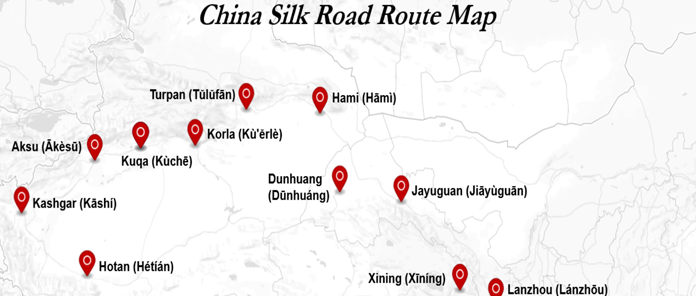
On our Silk Road Express journey with Glamour Trains, guests travel through Hami — not around it. The itinerary brings travelers directly into eastern Xinjiang, where oasis culture, Silk Road history, and the dramatic yardang landscapes of Hami come together as part of a wider journey westward.
This is more than a melon stop. It is the beginning of a conversation between flavor and place, between name and origin, between something you can hold in your hand and the vast landscape that made it possible. Travelers who pass through Hami on our rail journey often describe it as the moment the Silk Road stops feeling like history and starts feeling like somewhere real.
From Hami’s fields and yardang formations to the ancient cave art of Dunhuang, our Silk Road Express journey connects the destinations of western China in a way that road trips and flights simply cannot replicate. You move at the pace of the land, and you arrive with more than photographs.
Curious about our itineraries? Explore the Silk Road Express and discover what it means to travel the route that shaped the ancient world.
Frequently Asked Questions
Is Hami melon the same as cantaloupe?
No. While they are both muskmelons, Hami melon is generally sweeter and crisper, with a stronger regional identity tied to Xinjiang. The comparison is useful as a starting point, but the eating experience is noticeably different.
Where does Hami melon come from?
Hami melon is strongly associated with Xinjiang, China — especially the Hami and Turpan basin regions, where climate and soil conditions are particularly well suited to producing sweet, dense-fleshed melons.
Why is it called Hami melon?
It is named after Hami, the city and prefecture in eastern Xinjiang that became historically associated with the fruit’s production and quality.
How do I know when a Hami melon is ripe?
Look for a sweet aroma, a heavy feel for its size, and a slight give under gentle pressure. Very firm fruit with little scent usually needs more time at room temperature.
Is Hami worth visiting beyond the melon?
Very much so. Hami is a historic Silk Road gateway with layered cultural heritage and is also known for some of China’s most dramatic yardang desert landscapes.
What can travelers see in Hami besides fruit?
Hami offers Silk Road oasis culture, regional history, and extensive yardang formations recognized for their geological significance — making it a destination with significant depth beyond its agricultural identity.