




The Ultimate Guide to Visiting China in April 2026: Weather, Best Destinations & Expert Tips
April is arguably the finest month to travel in China.
Winter has fully retreated, the summer heat has not yet arrived, and across the country's vast and varied landscapes, spring is at its most expressive. Cherry blossoms give way to rapeseed fields and mountain wildflowers; by late April, the northwest's great deserts begin to warm towards more comfortable walking temperatures;Yunnan's valleys fill with colour. Compared to the crowded national holidays of May and October, April offers a genuine shoulder-season window — shorter queues, more affordable accommodation, and a more authentic, unhurried encounter with the places you visit.
This guide covers what to expect from the weather, highlights top destinations across China's diverse geography, and provides practical tips for making the most of one of the year's best travel months.
China's Weather in April: A Regional Overview
China's size means April weather varies enormously by region. Here is what to expect:
Northern China (Beijing, Xi'an): Warm and increasingly sunny, with daytime temperatures ranging from 12°C to 22°C. Spring dust storms are possible in early April, but by mid-month the air is typically clear. Evenings remain cool — a light jacket is still useful after dark.
Eastern and Southern China (Hangzhou, Guilin, Chengdu): Warm and pleasant, ranging from 15°C to 25°C. Humidity increases through the month, and spring showers are common — particularly in Jiangnan (the Yangtze River Delta region), where the famous soft spring rain is part of the landscape's appeal rather than an obstacle to it.
Yunnan Province: One of China's most consistently pleasant April destinations. The Yunnan Plateau maintains temperatures between 18°C and 26°C, with clear skies and low humidity across most of the province. The combination of altitude and latitude produces a spring that is warmer than Chengdu but cooler than coastal cities — ideal for outdoor exploration.
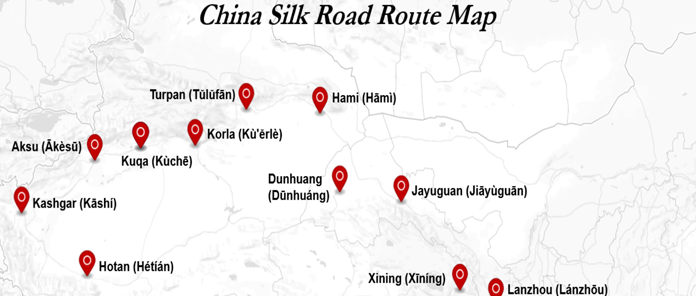
Northwest China (Dunhuang, Kashgar, Xining): Dry and clear, with daytime temperatures between 12°C and 20°C by late April. Nights are still cool, sometimes dropping close to freezing at higher elevations. The extreme summer heat is still two months away, making the period from late April into May one of the best windows of the year for Silk Road travel. UV radiation is intense — sun protection is essential.
Top Destinations: A Panoramic Journey Across China in April
1. North — Beijing: The Imperial Capital Without the Crowds
April in Beijing sits in a sweet spot between the last cold days of winter and the May holiday surge. The city's imperial monuments — the Forbidden City, the Temple of Heaven, the Summer Palace — can be explored at a pace that the summer months rarely permit.
The city's parks are at their finest in early April, when peach blossoms and forsythia colour the grounds around the historic monuments. By mid-month, the willows along the lakes of the Summer Palace are in full, soft leaf.
Practical tip: The Great Wall at Mutianyu is quieter than Badaling and significantly more photogenic in the clear spring light. Early mornings offer the best combination of good light and manageable crowds.
2. South — Guilin and Yangshuo: Mist, Karst and the Li River
April is widely considered the best month to visit Guilin. The spring rains — arriving more frequently than in winter but not yet at the heavy downpours of June — drape the karst peaks in soft mist, creating the atmospheric landscape that has defined Chinese ink-wash painting for centuries. The Li River runs full and clear.
Temperatures sit comfortably between 15°C and 22°C, ideal for cycling the back roads between Yangshuo's rice paddies, drifting downriver on a bamboo raft, or hiking to elevated viewpoints above the valley.
Practical tip: Book river cruise tickets at least two weeks in advance for April — demand is high and capacity is limited on the most scenic sections.
3. East — Hangzhou: Tea Harvest and West Lake in Bloom
The ancient Chinese saying places Hangzhou alongside heaven itself for good reason, and April is when that reputation is most fully earned. West Lake in early April is ringed with peach blossom and weeping willow in full leaf; the surrounding hills are a deep, saturated green.
More importantly, late March and early April mark the pre-Qingming harvest of West Lake Longjing (Dragon Well) tea — the most prized green tea in China. Picking takes place over a window of just a few weeks, and visiting the tea gardens during harvest is one of the most distinctive cultural experiences China offers in spring.
Practical tip: Head into Longjing Village or Meijiawu rather than staying near the tourist-facing areas of the lake. You can watch the harvest, taste freshly picked tea beside the plantation, and experience a side of Hangzhou that most visitors miss entirely.
4. Central — Wuhan: A City Transformed by Cherry Blossom
Wuhan's cherry blossom season peaks in mid-to-late March and extends into early April, making it one of China's most spectacular spring destinations. The campus of Wuhan University — where tens of thousands of cherry trees line the historic paths and buildings — is one of the most photographed scenes in the country during this period.
April also brings warmer, more settled weather than March, and the East Lake Cherry Blossom Garden offers a less crowded alternative to the university campus once the peak bloom passes.
Practical tip: Arrive at Wuhan University before 8am to beat the crowds and experience the canopy of blossoms in the soft morning light.
5. Southwest — Yunnan: Flowers, Ancient Railways and Living Culture
Yunnan in April is China at its most quietly extraordinary. The province's combination of high-altitude plateau, subtropical valleys, ancient minority cultures and — in spring — extraordinary floral landscapes makes it one of the most rewarding destinations in the country for travellers who want depth rather than spectacle.
The southwestern corner of Yunnan, around the Honghe region, is particularly compelling in April. The area around Shiping (石屏) — a small historic county seat with a 600-year-old old city, a Confucian temple of unusual refinement, and a century-old narrow-gauge railway that still runs through the spring countryside — sees the blooming of its distinctive wildflowers alongside Yilong Lake, creating a landscape of pink and green that feels entirely removed from the rest of China.
This is also the region traversed by the legendary Yunnan-Vietnam Railway (滇越鐵路) — a French-engineered metre-gauge line built in the early 20th century that connected Kunming to Hanoi and remains one of the great feats of colonial-era engineering. Riding a section of this historic railway through the Yunnan spring countryside is an experience with no equivalent elsewhere in China.
Practical tip: The Shiping area is best accessed from Kunming or Chengdu and rewards at least two days of exploration. April's mild temperatures and clear skies make it ideal for the outdoor activities and slow walking that the old city and lakeside require.
6. West — Dunhuang and Kashgar: The Silk Road in Spring
If you want vast spaces, profound history and a complete absence of crowds, the great Northwest from late April into early summer is unmatched.By late April, Xinjiang and Gansu are free from summer heatwaves and the package tour groups that descend from June onwards. The thousand-year-old murals of the Mogao Caves feel properly contemplative when you are not competing with hundreds of other visitors; the old city of Kashgar has a different quality entirely when explored at April's unhurried pace.
The northwest's main practical challenge — the enormous distances between destinations — is most elegantly solved by train. April light on the Gobi Desert, the Tianshan foothills and the Tarim Basin is exceptional: warm, directional, and at a low enough angle to give the landscape the drama it deserves. Watching this unfold through a train window, with nowhere to be and no itinerary to rush, is one of the finest travel experiences available in Asia in spring.
Practical tip: Book Mogao Caves tickets at least 30 days in advance, regardless of the season. April availability is better than summer, but the site operates on strictly timed entry and tickets sell out.
Practical Travel Tips for April in China
Packing: April demands layering. A lightweight down jacket or warm fleece handles cool mornings and evenings across most of the country; a lighter layer works for warm afternoons. In the northwest, add high-SPF sunscreen, a sun hat, sunglasses and heavy moisturiser — the dry air and intense UV at altitude are more aggressive than they appear.
Crowds and booking: April is a shoulder season, but Qingming Festival (April 4–6 in 2026) generates a domestic holiday surge. Book accommodation and popular attraction tickets around this date well in advance. Outside the holiday weekend itself, crowds are manageable across most destinations.
Budget: As a shoulder season, April typically brings 15–25% discounts on domestic flights and upmarket hotels compared to the May holiday peak. Some scenic areas also offer off-peak pricing before May.
Payments: China's digital payment ecosystem is now accessible to international visitors. Download Alipay or WeChat Pay before your trip and link your international credit card (Visa or Mastercard). From restaurants to scenic area ticket machines, the QR code scan covers almost everything.
Experience Yunnan by Luxury Train: The Silk Road Express Chengdu–Shiping Route
For travellers who want to experience the Yunnan spring in the most distinctive way possible, the Silk Road Express by Train of Glamour operates a 3-day, 2-night itinerary departing from Chengdu and travelling into the heart of southern Yunnan.
The journey begins at Chengdu West Station, where guests board the Silk Road Express in the afternoon. The first evening sets the tone immediately: a Yunnan cultural scholar delivers an on-board talk tracing the history of the century-old Yunnan-Vietnam Railway — the metre-gauge line that once connected Kunming to Hanoi and through which the cultures of southern Yunnan were shaped. This is followed by a dinner of Michelin-quality cuisine in the dining car, a signature cocktail reception, and the option to watch a film from the panoramic observation carriage as the train moves through the night.
Day two is spent in and around Shiping. The morning begins with a ride on the historic Shiping metre-gauge railway between Lian'an Station and Tuanshan Station — a journey through the Yunnan spring countryside on one of China's last surviving sections of colonial-era narrow-gauge track. Lunch is served at the century-old Shiping Railway Station itself: a French long-table banquet prepared by the train's executive chef, using the freshest seasonal vegetables, mushrooms and flowers of the Yunnan spring, with the afternoon sun gilding the old station platform.
The afternoon offers a choice of two experiences: cycling or walking along the shores of Yilong Lake through the blooming wildflower meadows (Route A), or exploring the Shiping Railway Museum and the old city — including the house of Yuan Jiagu, a late Qing imperial scholar, and the remarkably preserved Shiping Confucian Temple (Route B). The evening returns to the train for a themed Han Dynasty court banquet dinner followed by an immersive Silk Road micro-theatre experience, in which guests become members of a Tang Dynasty caravan — handling silk from Chang'an, smelling Persian spices and decoding star maps of the desert.
Day three returns to Chengdu in the morning, after breakfast aboard the train.
This itinerary is designed for the April spring season specifically — the wildflower blooming at Yilong Lake and the particular quality of Yunnan's spring light are central to the experience. It offers something that no other travel format in China currently provides: the historic narrow-gauge railway, the century-old station lunch, and the deep cultural context of a region that most tourists pass through without understanding.
FAQ for International Travellers
Q: Is April too cold to visit China? It depends on your destination. Beijing and Xi'an in early April still require a warm layer for evenings (around 10°C), while Yunnan and Guilin are comfortably warm throughout (18–25°C). The northwest (Dunhuang, Kashgar) is pleasant by day but cool at night — layers are essential.
Q: Are there major holidays or crowds in April? The Qingming Festival holiday (April 4–6 in 2026) generates a short domestic travel surge. Outside those dates, April is a genuine shoulder season — shorter queues, lower prices, and more authentic encounters with local life than the major national holidays permit.
Q: Is April a good time for the Silk Road in western China? From late April onwards, yes. The northwest in this period is dry, clear and free from summer heat. The light is exceptional for photography, the distances between sites are manageable without the exhaustion of summer temperatures, and the major attractions are significantly less crowded than in July and August.
Q: What is the Yunnan-Vietnam Railway? The Yunnan-Vietnam Railway (滇越鐵路) was a French-engineered metre-gauge railway completed in 1910, connecting Kunming to Hanoi via 854 kilometres of extraordinary mountain terrain. It was one of the most technically ambitious railway projects of its era, crossing hundreds of bridges and tunnels through the mountains of southern Yunnan. Sections of the line still operate today, and riding them offers a direct encounter with a layer of Yunnan's history that most visitors never access.
Q: How do international tourists handle payments in China? Download Alipay or WeChat Pay before travelling and link your international Visa or Mastercard. This covers the vast majority of transactions — restaurants, transport, scenic area tickets, shops — via QR code. Carry a small amount of cash as backup for rural areas and older establishments.
Q: What makes April better than March for China travel? April is warmer, more settled, and botanically more spectacular than March across most of the country. The Yunnan wildflowers peak in April rather than March; West Lake Longjing tea harvest falls in late March to early April; the northwest deserts reach their most comfortable conditions from late April rather than in the still-chilly March. The shoulder-season advantages — lower prices, smaller crowds — apply equally to both months.
The Best Month to See China at Its Most Itself
March has its admirers, and rightly so. But April is when China's spring fully declares itself — when the landscapes that were tentatively beginning in March are now unambiguously alive, and when the weather across the greatest range of destinations is at its most cooperative.
Whether you want to feel the spring in Hangzhou's tea gardens, trace the ancient caravan routes through the deserts of Dunhuang, or ride a century-old narrow-gauge railway through the wildflower meadows of southern Yunnan, April rewards you with the particular quality that only a fully arrived spring can provide: the sense that the world has started again, and that you are in exactly the right place to see it.