




Gobi Desert: Exploring the Silk Road Express Route Through China's Desert Landscapes
Most people know the Gobi Desert from maps and history books. They see it as a brown patch across northern Asia. Very few understand what it actually looks and feels like from ground level.
The Gobi Desert is not a sea of sand dunes. It is a vast, complex landscape of rock, gravel, dry riverbeds, and occasional sand formations. Ancient Silk Road traders crossed it. Chinese dynasties built walls to mark their edge. Today, the Silk Road Express route passes directly through its heart.
This guide explains what the Gobi Desert is, where it lies, what you will see while traveling through it, and why it is one of the most compelling landscapes on the Silk Road Express journey.
What Is the Gobi Desert?
The Gobi Desert is one of the largest deserts in Asia. It covers approximately 1.3 million square kilometers across northern China and southern Mongolia. It is the fifth largest desert in the world by total area.
Most people picture deserts as endless sand dunes. The Gobi Desert does not match that image. The majority of its surface is rocky. Hard, flat gravel plains stretch for hundreds of kilometers. Dunes exist but are concentrated in specific areas rather than spread across the entire desert.
The Gobi Desert is also cold. Winter temperatures regularly drop below minus 30 degrees Celsius. Summer temperatures can exceed 40 degrees Celsius at the surface. This extreme temperature range within a single landscape gives the Gobi Desert a character all its own.
Where Is the Gobi Desert Located?
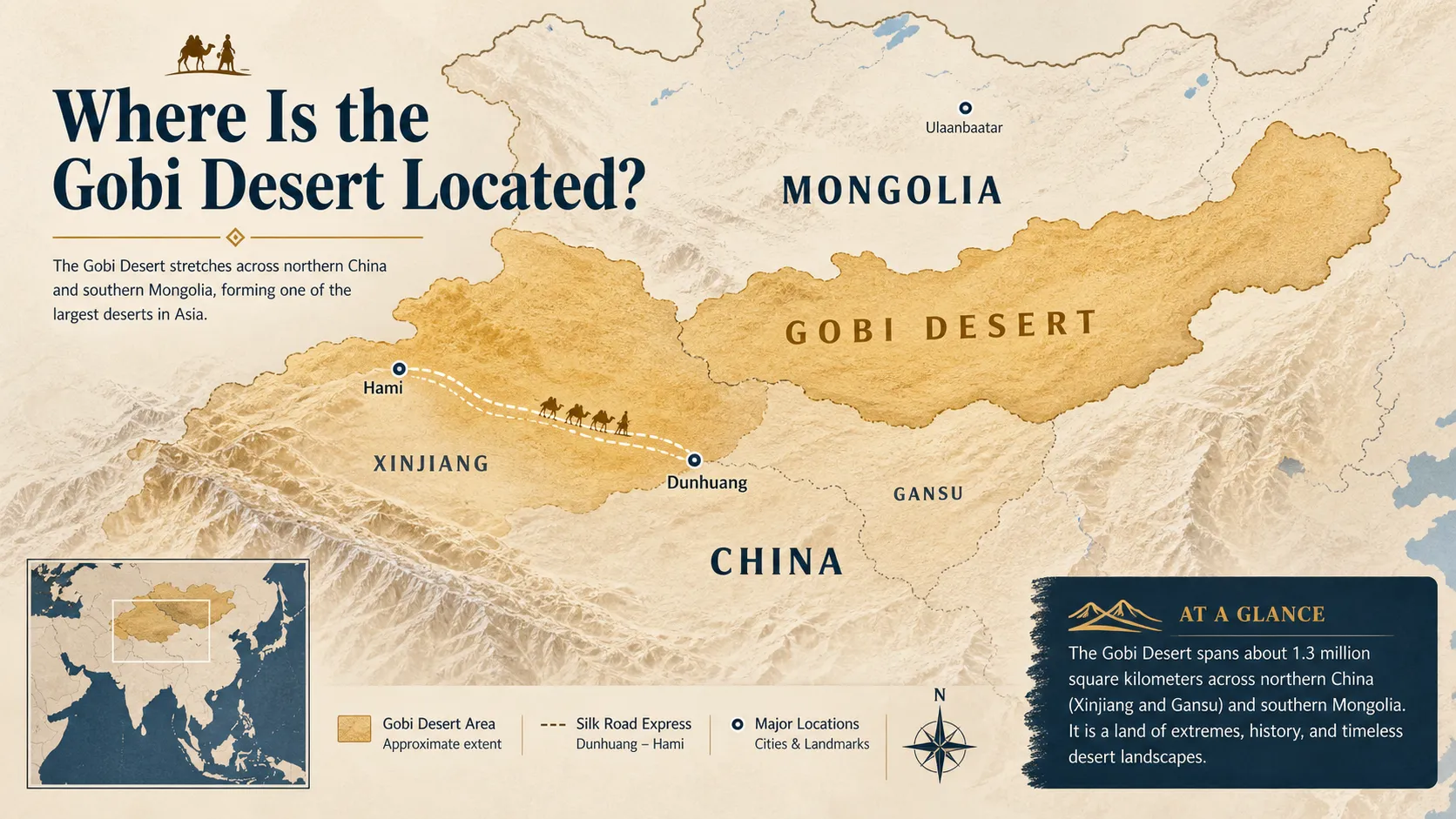 The Gobi Desert sits across northern and northwestern China and extends into southern Mongolia. It is bordered by the Altai Mountains to the north, the Tibetan Plateau to the southwest, and the North China Plain to the southeast.
In China, the Gobi Desert spans two regions directly relevant to the Silk Road Express route. The first is Gansu Province, which contains the Hexi Corridor, Dunhuang, and the historic Yumen Pass. The second is Xinjiang, which contains Hami and the broader desert landscapes of the Turpan Depression.
The Gobi Desert in Mongolia covers the southern part of that country. This section is sometimes called the Mongolian Gobi in regional references.
On a map of the Gobi Desert in Asia, the desert appears as a large, irregular shape running roughly northeast to southwest. The Silk Road Express focuses on the Chinese side of the desert, where the most historically significant stops are found. Its route cuts through its southern and western edges, where the most dramatic landscapes are concentrated.
Gobi Desert Map and Silk Road Route
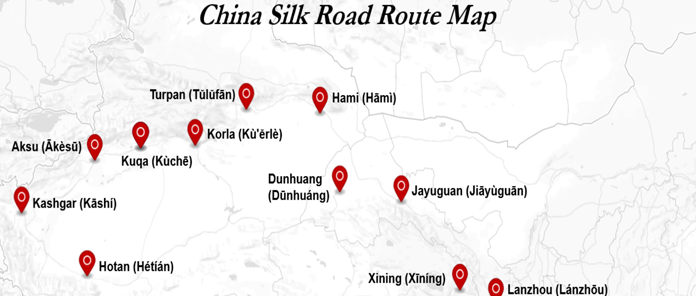
On any map of the Gobi Desert, two cities stand out as the most important stops for Silk Road Express travelers: Dunhuang and Hami.
Dunhuang sits at the western edge of Gansu Province. It was one of the most critical cities on the ancient Silk Road. Caravans entering China from Central Asia first passed through Dunhuang. The Mogao Caves nearby contain some of the most significant Buddhist art ever discovered. The city sits at the edge of the desert, surrounded by rock and sand that have changed very little since the Silk Road’s peak centuries ago.
Hami sits further west in Xinjiang. It was the eastern gateway into Xinjiang on the ancient Silk Road. Travelers crossing the desert from the east reached Hami before continuing toward Turpan, Urumqi, and Kashgar. Both cities lie directly on the Gobi Desert corridor and are stops on the Silk Road Express.
How the Silk Road Express Connects to the Gobi Desert
The Silk Road Express passes through the Gobi Desert corridor as a core part of its route. The train travels through Gansu Province and into Xinjiang, covering hundreds of kilometers of desert terrain. This is not a route that skirts the desert edge. It goes through the middle of it.
From the train window, the desert landscape changes continuously. Rocky plains give way to eroded rock formations. Dry riverbeds appear and disappear. Occasional green patches mark underground water sources that sustained oasis settlements for thousands of years.
The Silk Road Express combines rail travel with off-train excursions at each major stop. In Dunhuang, travelers explore the dunes, the Crescent Lake, and the Mogao Caves. In Hami, the excursion takes travelers to the Dahaidao Yardang Scenic Area. These ground-level experiences bring the Gobi Desert directly to the traveler rather than keeping it at a distance through a train window.
Best Gobi Desert Landscapes on the Silk Road Express Journey
TheSilk Road Express Luxury Routes-Train Of Glamour takes you to some of the worth seeing places in the Gobi Desert.
Dunhuang Sand Dunes
The Mingsha Shan dunes outside Dunhuang rise to 250 meters. They are surrounded by rocky desert terrain on all sides. The contrast between soft sculpted sand and hard gravel plains is visually striking.
At the base of the dunes sits Crescent Lake, a small oasis that has maintained water for centuries despite sitting in the middle of the desert. The lake and the dunes together create one of the most iconic desert images in all of China. Camel trains still operate at the dune base for visitors.
The Mogao Caves nearby contain 492 cave temples with murals painted between the 4th and 14th centuries. The historical weight of the Silk Road is visible in every direction here.
Hami Yardang Landforms
The Hami Dahaidao Scenic Area contains one of the most unusual desert landscapes in China. Wind has eroded the rock surface over millions of years, creating a field of irregular towers, ridges, and formations across the Gobi Desert floor.
The shapes are dramatic. Some look like castle walls. Others resemble giant animals frozen in rock. Surface colors range from deep red to pale yellow, depending on mineral content and the time of day.
At sunrise and sunset, the landscape takes on a red-orange tone that photographers consistently describe as Mars-like. Ancient beacon towers and post stations from the Silk Road era are still visible from the road.
Open Gobi Plains
Between the dramatic formations at Dunhuang and Hami, the Silk Road Express passes through long stretches of open Gobi Desert plain. Flat, wide, dry, and completely open to the horizon. From the train window, these plains extend further than the eye can follow.
Small desert settlements appear occasionally, marking the same oasis points that Silk Road caravans once depended on for water and rest. This open landscape connects the dramatic stops along the route and gives the journey its sense of crossing something real and continuous.
What Makes the Gobi Desert Different from Other Deserts?
Three things separate the Gobi Desert from most deserts people are familiar with. The rocky terrain is the first distinction. Approximately 70 to 80 percent of the Gobi Desert surface is exposed rock and gravel rather than sand. This gives the landscape a harder, more permanent quality than dune deserts.
The extreme weather is the second distinction. The Gobi Desert experiences one of the widest temperature ranges of any desert on earth. It sits at high elevation, far from any ocean that could moderate its climate. This produces genuinely dangerous winters and intensely hot summers.
The vast open space is the third distinction. The Gobi Desert is large enough that crossing it feels like crossing an ocean. There are no landmarks for long stretches. This was the quality that made the ancient Silk Road crossing so difficult and what makes the modern train journey through it so striking.
Best Time to Visit the Gobi Desert
Spring and autumn are the best seasons for travel to the Gobi Desert. April to June and September to October offer manageable temperatures, clear skies, and good conditions for photography and outdoor exploration.
Spring brings mild temperatures and soft light that summer heat removes. Visibility is typically excellent across the open desert. Autumn is many photographers’ preferred season. The angle of light is lower than in summer, and the landscape takes on warmer color tones as the season progresses.
Summer travel is possible but requires careful preparation. Surface temperatures on exposed rock can reach 70 degrees Celsius at midday. Travel during summer requires activity only in the early morning and late afternoon. Winter travel is for experienced desert travelers only. Temperatures drop below minus 30 degrees Celsius with wind chill, making it significantly colder.
Travel Tips for Gobi Desert Exploration
Carry more water than you think you need at every desert stop. Dehydration occurs more quickly at high temperatures and low humidity than most travelers expect. A minimum of two liters per person per day is a starting point.
Sun protection is not optional. UV exposure at desert elevations with clear skies is intense. Sunscreen, a wide-brim hat, and UV-blocking sunglasses are essential for any outdoor time in the desert.
Prepare for temperature swings between morning and afternoon. Layered clothing that can be added or removed quickly is the practical approach for any season. For photography, plan to arrive at the primary locations before sunrise and return to the shelter by 10 AM. Go out again two hours before sunset. The light in these windows produces dramatic shadow and color that midday light eliminates.
Gobi Desert vs Other Silk Road Landscapes
The Silk Road Express passes through several distinct landscape types. The Gobi Desert provides the broadest and most continuous desert experience on the route.
Landscape Experience: Gobi Desert, open, rocky, dry, and historically charged. Taklamakan Desert: Deeper dunes and oasis routes. Pamir Plateau: High mountain peaks and alpine lakes
The Gobi Desert defines the middle section of the Silk Road corridor. The Taklamakan is more intense and more remote. The Pamir Plateau is a stark contrast, with its mountainous scale and high-altitude cold. Together, these three landscape types create a journey where the scenery changes completely every few days.
Conclusion
The Gobi Desert is more than a place on a map. It is one of the most important landscapes in the history of the Silk Road. For centuries, traders traversed this region, helping shape Asia’s culture and trade routes. Today, Silk Road Express makes it much easier for travelers to experience these desert landscapes. Stops like Dunhuang and Hami bring you close to some of the most dramatic scenery on the route. You do not need special skills to experience the Gobi Desert. You only need time, clear weather, and the willingness to slow down and take in the landscape’s silence.
FAQs
Where is the Gobi Desert located?
The Gobi Desert spans northern and northwestern China and southern Mongolia. In China, it covers significant portions of Gansu Province and Xinjiang. On a map of the Gobi Desert in Asia, it appears as a large irregular zone running roughly northeast to southwest across the region.
Is the Gobi Desert part of the Silk Road route?
Yes. The Gobi Desert was a central feature of the ancient Silk Road. Traders crossing from Central Asia into China passed through the desert corridor via Dunhuang, Hami, and Turpan. The Silk Road Express follows this same corridor today.
Can you visit the Gobi Desert on the Silk Road Express journey?
Yes. The Silk Road Express passes directly through the Gobi Desert corridor. Dunhuang and Hami are the primary stops where travelers can explore the desert landscape directly through off-train excursions to the sand dunes, Crescent Lake, and the Hami Yardang formations.