




Kashgar on the Silk Road: History, Culture and Travel Experience
There is a common misconception about the Silk Road: that it was, primarily, a road. In reality, it was never a single path. It was a vast, shifting network of routes — some crossing deserts, others climbing mountain passes — that connected civilisations across thousands of kilometres for more than a millennium. Merchants, pilgrims, ambassadors and scholars all moved through this network, carrying with them not only silk and spices but languages, religions, technologies and ideas.
At the western edge of China, where the routes converged before pushing on into Central Asia, one city stood at the centre of it all.
Kashgar — known in Chinese as Kashi (喀什) — was not simply a stop along the Silk Road. It was the point where the road's two great southern and northern branches reunited, where East met West in the most literal geographical sense, and where the commercial, religious and cultural energy of the ancient world found its most concentrated expression. To understand the Silk Road is, in large part, to understand Kashgar.
What Is the Silk Road?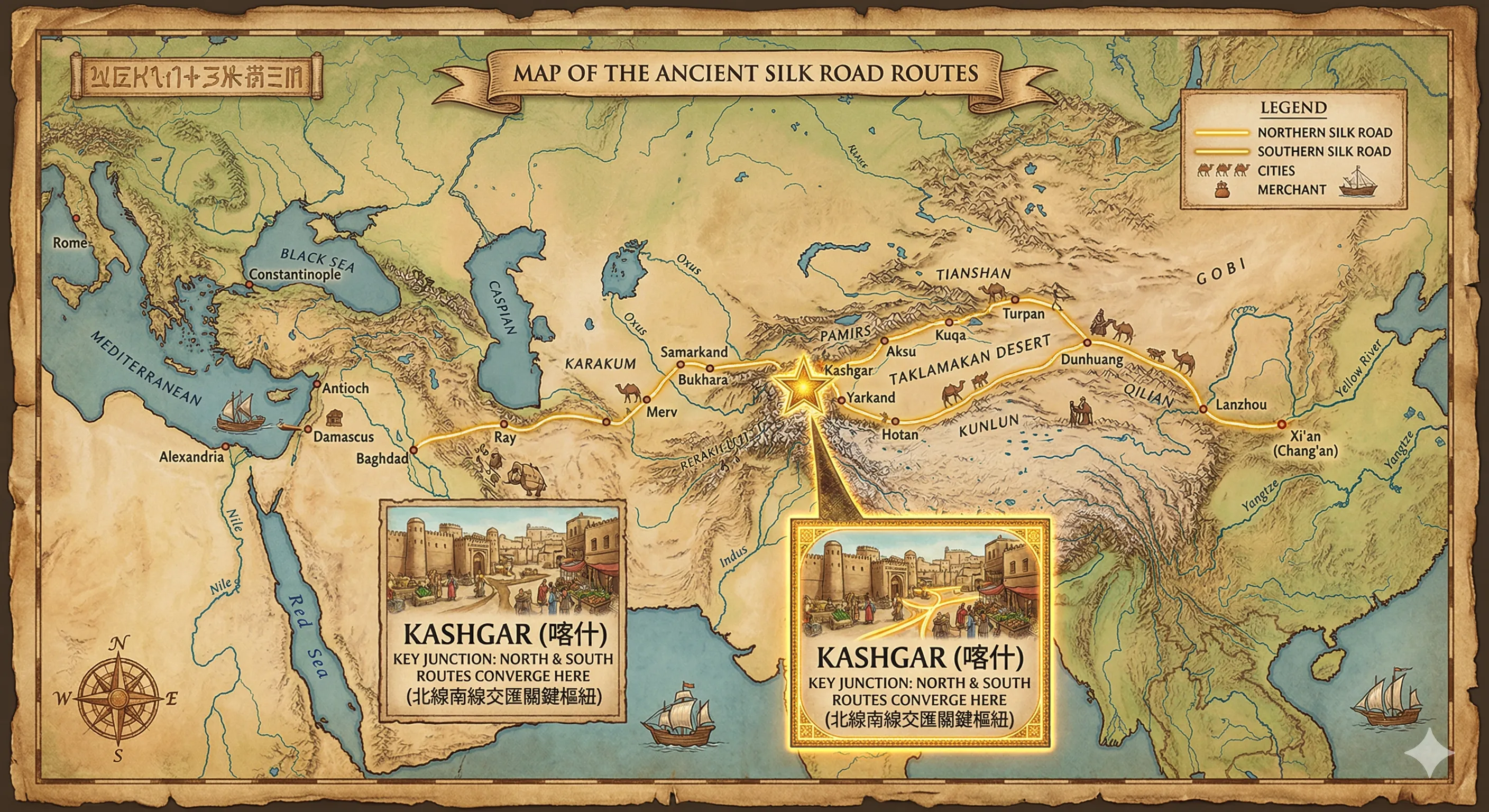
The term "Silk Road" was coined by the German geographer Ferdinand von Richthofen in 1877, though the routes it describes had been in active use for centuries before he named them. At its height — roughly from the Han Dynasty (206 BCE – 220 CE) through to the Ming Dynasty — the Silk Road connected China's imperial capitals to the Mediterranean world, passing through Central Asia, Persia, the Arabian Peninsula and eventually reaching Rome and Constantinople.
As UNESCO's Silk Roads Programme documents, these routes were far more than commercial arteries. They were channels through which Buddhism, Islam, Christianity and Zoroastrianism spread across continents; through which mathematical, astronomical and medical knowledge moved between civilisations; and through which art forms, architectural styles and culinary traditions were exchanged in ways that permanently altered the cultures they touched. The Silk Road was, in the fullest sense, the internet of the ancient world — a network that accelerated the transmission of everything humanity knew and made.
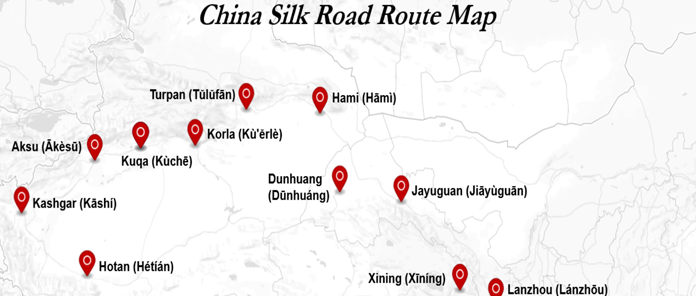
The routes were broadly divided into two main corridors. The northern route skirted the edge of the Gobi Desert and the Tianshan Mountains. The southern route traced the northern edge of the Tibetan Plateau and the Kunlun range. Both routes passed through Dunhuang — where the famous Mogao Gottoes (Mogao Caves) stand as testament to the Buddhist culture that flourished here — before diverging around the formidable Taklamakan Desert. They would not reunite until they reached a single point at the desert's western edge.That point was Kashgar.
Why Kashi(Kashgar) Was the Heart of the Silk Road
Geography made Kashi(Kashgar) inevitable.
Situated at the western terminus of the Taklamakan Desert, at the foot of the Pamir Mountains, Kashgar occupies one of the most strategically significant positions in Asian geography. The Pamirs — often called the "Roof of the World" — form a knot of mountain ranges where the Tianshan, Kunlun, Karakoram and Hindukush ranges converge. The passes through these mountains were the only practical routes between China and the civilisations to the west: Persia, Sogdia, Bactria and, beyond them, the Mediterranean.
Any merchant travelling from China to the west, or from the west to China, had no choice but to pass through Kashgar. It was the funnel through which the entire Silk Road trade had to flow.
This geographic inevitability made Kashgar one of the most important commercial cities in the ancient world. UNESCO's Tentative World Heritage List documentation on the Silk Road sites of Xinjiang notes that Kashgar served as a critical junction linking the northern and southern Silk Road branches — a role it maintained continuously for over two thousand years. Merchants arriving from the east after crossing the Taklamakan would rest, resupply and trade in Kashgar before attempting the mountain passes westward. Those arriving from the west would do the same before beginning the desert crossing eastward.
The result was a city of extraordinary commercial vitality. At its peak, Kashgar's markets traded in silk, jade, cotton, glass, gold, horses, spices, dyes and dozens of other commodities moving in both directions between China and the Mediterranean. The city grew wealthy on the tariffs, exchange services and hospitality that this constant flow of trade demanded.
But Kashgar's importance was never purely commercial. Because it stood at the meeting point of so many different civilisations' spheres of influence, it became one of the most culturally complex cities in the ancient world — a place where Chinese, Persian, Turkic, Indian, Sogdian and eventually Arab cultures all left permanent marks on the city's architecture, language, music, food and religious life.
A Crossroads of Cultures and Trade
The culture that emerged in Kashgar over two millennia of Silk Road activity is unlike anything found elsewhere in China — or, for that matter, anywhere else in Central Asia. It is a genuine synthesis, the product of centuries of cultural exchange at the most intensive crossroads of the ancient world.
Islam arrived in Kashgar in the 10th century and became the dominant religion of the region, permanently shaping its architecture, social life and artistic traditions. The city's mosques — most prominently the Id Kah Mosque, one of the largest in China — became centres not only of religious practice but of community life, scholarship and political authority. The Islamic calendar structured the rhythm of Kashgar's days and weeks; the mosque's call to prayer still marks the passage of time in the old city today.
The bazaar culture that developed in Kashgar over centuries remains one of the most vivid expressions of its Silk Road heritage. Encyclopædia Britannica's entry on Kashgar describes it as historically one of Central Asia's most important trading centres, a status reflected in the extraordinary variety of its markets. The Grand Bazaar — selling everything from hand-forged knives and copperware to silk fabrics, dried fruit and livestock — was not simply a marketplace but a social institution, a place where news was exchanged, disputes were mediated and the commercial relationships that sustained the Silk Road were maintained.
The craft traditions that the Silk Road brought to Kashgar are equally remarkable. Uyghur artisans developed distinctive traditions in copperwork, knife-making, silk weaving, woodcarving and musical instrument production — particularly the dutar and rawap, string instruments whose music remains central to Uyghur cultural identity. The tea houses that lined Kashgar's old streets served as informal meeting places for merchants from a dozen different cultures, each conducting business in their own language while sharing a common table. These institutions — the bazaar, the tea house, the caravanserai — were the social infrastructure of the Silk Road, and Kashgar developed them to their highest expression.
Kashgar Old City: Living Silk Road Heritage
Most ancient cities of the Silk Road exist today primarily as archaeological sites: ruins in the desert, preserved cave complexes, excavated foundations. Kashgar is a remarkable exception.
The old city of Kashgar — the dense, organic labyrinth of mud-brick architecture, artisan workshops and narrow alleys that covers the hillside northeast of the city centre — has been continuously inhabited for over two thousand years. It is one of the few places in the world where the physical environment of a Silk Road city can be experienced directly, as a living community rather than a museum exhibit.
The architecture of the old city reflects its history of cultural synthesis. Buildings are constructed in a distinctive style that blends Central Asian, Persian and local Uyghur elements: thick mud-brick walls that provide insulation against the extreme temperatures of the Tarim Basin, intricately carved wooden balconies and doorways, and internal courtyard layouts that provide shade and privacy in the desert climate. Streets are narrow and winding — the organic product of centuries of incremental construction rather than any planned grid — and open unexpectedly onto small squares where neighbours gather, craftsmen work and children play.
Walking through the old city, you pass workshops where coppersmiths hammer intricate patterns into pots and trays using techniques unchanged for generations; hat makers produce the distinctive Uyghur doppa caps in embroidered silk; knife makers grind and polish the famous Yengisar blades that have been a Kashgar speciality for centuries. The smell of fresh naan bread baking in clay ovens drifts through the lanes. The sound of a dutar being played in a courtyard somewhere nearby carries over the rooftops.
This is not a reconstructed heritage experience. It is a neighbourhood where people live, work and conduct their daily lives in a physical environment that has preserved, more than almost anywhere else on earth, the texture of Silk Road urbanism.
Things to Experience in Kashgar
The Sunday Livestock Market
One of the great Central Asian bazaar experiences, the Sunday livestock market on the outskirts of Kashgar has drawn traders from across the region for generations. Thousands of sheep, goats, cattle, horses and camels are bought and sold each week in a scene of organised commercial chaos that bears more resemblance to medieval trade fairs than to anything in the modern world. The market is not a tourist attraction that has been preserved for visitors — it is a functioning economic institution, and the energy of genuine commerce makes it unlike anything staged.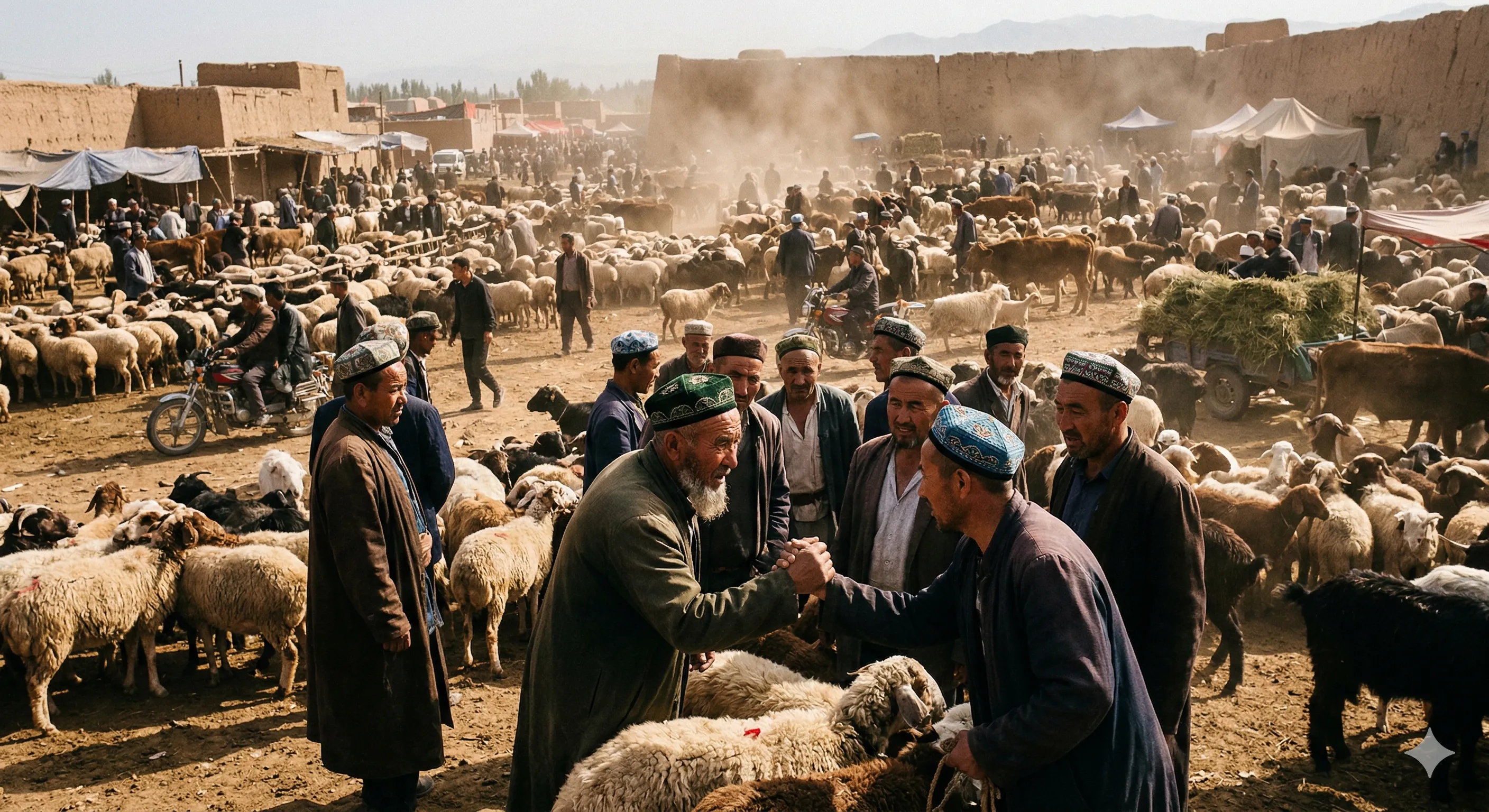
The Id Kah Mosque
The largest mosque in China, the Id Kah has stood in its current location since 1442, though a mosque has occupied this site since the 9th century. The yellow-tiled facade and twin minarets anchor the main square of the old city; the courtyard inside can accommodate tens of thousands of worshippers for Friday prayers and the great festivals of Eid. Visitors are welcomed outside of prayer times.
The Old City Streets and Craft Workshops
The old city rewards slow exploration without a fixed itinerary. The most interesting encounters tend to happen when you turn down an unmarked lane and find yourself in a coppersmith's workshop, or come across a baker pulling naan from a clay oven, or hear music coming from a courtyard and discover a musician repairing his instrument. The Gaotai Folk Houses — a cluster of traditional Uyghur dwellings perched on a 40-metre-high loess cliff overlooking the old city — offer both panoramic views and a concentrated experience of traditional architecture and crafts.
The Grand Bazaar and Specialist Markets
Beyond the Sunday livestock market, Kashgar's daily bazaars offer a more manageable introduction to the city's commercial culture. Specialist markets for fabric, spices, dried fruit, jewellery, ceramics and musical instruments are scattered through the old city and surrounding neighbourhoods, each with its own character and clientele.
Best Time to Visit Kashgar
Kashgar's climate is continental and arid — hot summers, cold winters, and very little rainfall year-round. The best seasons for visiting are spring and autumn, when temperatures are moderate and the city's outdoor life is at its most active.
Spring (April – May) brings warming temperatures and the blossoming of fruit trees throughout the Kashgar oasis. The city is at its most photogenic, with flowers framing the old city's mud-brick architecture. Tourist numbers are manageable at this time of year.
Summer (June – August) is peak season — and peak heat. Daytime temperatures regularly exceed 35°C, and can reach 40°C or above. Early morning and evening are the most comfortable times for exploration; the midday hours are best spent in shaded tea houses or resting in your hotel. The bazaars are at their most energetic, and the surrounding Pamir landscape is accessible by road.
Autumn (September – October) is the season most recommended by experienced visitors. Temperatures are ideal, the harvest season brings additional energy to the markets, and the light quality in the late afternoon — warm and low-angled — is extraordinary for photography. The Pamir road to Tashkurgan and Karakul Lake is still open, and the surrounding landscape takes on the golden tones of the season.
Winter (November – March) is cold and quiet. Many tourist facilities reduce their hours, and the mountain roads become difficult. However, the city itself remains accessible and is visited by far fewer tourists — for those who don't mind the cold, winter Kashgar offers a more intimate encounter with daily life in the old city.
How Kashgar Connects the Silk Road Today
The ancient function of Kashgar — as the point where east-west routes converge at China's western gateway — has not disappeared. It has been modernised.
The completion of the Karakoram Highway connecting Kashgar to Pakistan remains one of the great engineering achievements of the 20th century, threading through some of the world's most challenging mountain terrain to recreate, in modern form, one of the Silk Road's most important western routes. The highway carries goods, people and commercial relationships across the Pamirs today much as the ancient mountain passes did for centuries before it.
Domestically, Kashgar has been connected to the national rail network, with the line from Ürümqi completing what was once a journey of many days into a trip of under six hours. This rail connection has made Kashgar accessible to Chinese domestic travellers in unprecedented numbers, and has begun to open the city to international visitors who previously might have been deterred by its remoteness.
China's Belt and Road Initiative — widely understood as a contemporary reimagining of the Silk Road's logic of connectivity — has invested heavily in infrastructure throughout the Xinjiang region, with Kashgar designated as a special economic zone and a key node in China's westward commercial expansion. The city that was the Silk Road's most important junction two thousand years ago has been, in a meaningful sense, re-appointed to the same role in the 21st century.
Travelling the Silk Road Through Kashgar
For the modern traveller, reaching Kashgar requires a conscious decision to go further than most tourists venture. It sits at the edge of China's map, separated from the country's major population centres by the Gobi Desert, the Tianshan Mountains, and the vast expanse of the Taklamakan. This remoteness is, paradoxically, part of its appeal: Kashgar has not been homogenised by mass tourism in the way that more accessible destinations have.
The most meaningful way to approach Kashgar is not to treat it as a single destination but as the culmination of a journey — ideally one that retraces, at least partially, the logic of the ancient routes. Arriving in Kashgar after travelling through the landscapes and cultures of the Silk Road corridor gives the city a context that arriving by direct flight cannot provide.
The overland approach from the east — through Dunhuang and its Mogao Caves, across the Hami Desert, through Ürümqi and the Tianshan passes, past the azure surface of Sayram Lake, through the ancient Buddhist sites of Kucha — transforms Kashgar's old city from an interesting destination into a genuinely felt arrival. You understand, viscerally, why this city mattered: because you have just crossed the desert and the mountains that made it necessary.
A Silk Road Journey by Train
The challenge of travelling this corridor independently is the same one that faced Silk Road merchants: the distances are enormous, the terrain is demanding, and the logistics of moving between destinations require careful planning and considerable time.
One approach that resolves these challenges while adding a dimension that independent road travel cannot offer is the Silk Road Express by Train of Glamour — a private luxury train journey that traces the Silk Road corridor from Xining, on the edge of the Tibetan Plateau, through to Kashgar.
The 7-day Silk Road Gold Autumn itinerary is designed around one of the region's most spectacular seasonal phenomena: the turning of the Euphrates poplars in October. Departing from Xining, the route passes through the surreal Yardang desert landscape of Hami before reaching the Tarim Poplar Forest in Luntai — home to the world's largest natural stand of ancient poplars, their leaves blazing gold and amber against the desert sky in a display that lasts only a few weeks each autumn. The journey then continues to Kashgar, where two full days allow for deep exploration of the old city, the Gaotai Folk Houses with traditional craft workshops, and a Muqam cultural dinner — a form of Uyghur classical music and poetry that UNESCO has recognised as an Intangible Cultural Heritage of Humanity. An optional day trip extends to the Pamir Plateau, taking in the white sand dunes and sapphire waters of Baisha Lake and the mirror-still surface of Karakul Lake at the foot of Muztagh Ata.
Throughout the journey, expert cultural guides accompany every stop, providing the kind of historical and cultural context that transforms a visit to a beautiful place into a genuinely felt encounter with history. Dedicated tourism ambassadors and professional photographer travel with each group from start to finish.
The train itself handles the vast distances of the Silk Road corridor in comfort: private cabins serve as a moving base from which to experience the landscape, with the Gobi Desert, Tianshan foothills and Tarim Basin unfolding through large windows as you travel. The in-between moments — which independent travellers often experience as exhausting transit — become, aboard the Silk Road Express, some of the most memorable of the journey.
It is, in a sense, the closest thing available to experiencing the Silk Road as it was meant to be experienced: as a journey that is complete in itself, where the route matters as much as the destination.
FAQ
Q: Where exactly is Kashgar located? Kashgar is located in the far southwest of China's Xinjiang Uyghur Autonomous Region, at the western edge of the Tarim Basin and the eastern foot of the Pamir Mountains. It sits approximately 1,500 kilometres west of Ürümqi, and shares geographic proximity with the borders of Tajikistan, Kyrgyzstan, Afghanistan and Pakistan.
Q: Is Kashgar safe to visit? Kashgar is accessible to tourists and visited by both domestic Chinese and international travellers. Visitors should check current travel advisories from their home country's foreign affairs ministry before planning a trip, as entry requirements and local conditions can change.While China currently offers visa-free entry for short stays to many Western nationalities, a standard Chinese tourist visa is required for longer journeys or non-exempt passports, which should be arranged well in advance.
Q: What language is spoken in Kashgar? The predominant language of daily life in Kashgar is Uyghur, a Turkic language written in a modified Arabic . Mandarin Chinese is also widely spoken, particularly in commercial and official contexts. Very little English is spoken in the old city and markets; having a guide or translation app is strongly recommended for independent travellers.
Q: Do I need a special permit to visit Kashgar? Visiting Kashgar itself does not require a special permit for most travellers beyond a standard Chinese tourist visa. However, travel to border areas such as the Pamir Plateau (Tashkurgan) requires a Frontier Pass (边防通行证), which must be arranged in advance and in person at the designated permit office. This applies to all foreign nationals, as well as residents of Hong Kong and Macau.
Q: How do I get to Kashgar? Kashgar is served by an airport with domestic flights connecting to Ürümqi and other major Chinese cities. It is also connected to the national high-speed rail network, with the line from Ürümqi reducing the journey to approximately five to six hours. From Ürümqi, connections to major Chinese cities including Beijing, Shanghai and Chengdu are available by air and rail.
Q: How many days should I spend in Kashgar? A minimum of two to three days is recommended to experience the old city, the Sunday bazaar and the surrounding areas meaningfully. Three to four days allows for a day trip to the Pamir Plateau and Karakul Lake, which most visitors consider the highlight of the wider region. Approaching Kashgar as the culmination of a longer Silk Road journey — rather than as a standalone destination — provides the richest possible context for everything you see here.
Q: What is the best time of year to visit Kashgar? Spring (April–May) and autumn (September–October) are the most comfortable and visually rewarding seasons. Autumn in particular — when the Euphrates poplars turn gold across the Tarim Basin and the light quality in the late afternoon is exceptional — is considered by many experienced travellers to be the finest time to be in this part of the world. Summer is hot but energetic; winter is cold and quiet, with far fewer visitors.