




Tibetan Buddhism: Beginning the Journey at Kumbum Monastery
For many travelers, the first encounter with Tibetan Buddhism is not through books, but through images — golden rooftops catching the morning sun, spinning prayer wheels worn smooth by generations of hands, monks in deep crimson robes, the low resonance of chanting filling a dimly lit hall, and walls alive with murals in colors that seem to glow from within. These are powerful impressions, yet they can also feel distant, as though they belong to a world that requires years of study before it can be properly understood.
In reality, understanding Tibetan Buddhism does not require becoming a scholar. For travelers, walking into a truly significant monastery with a little context — and allowing the architecture, art, and atmosphere to speak — is often the most direct way in.
For those beginning their journey in Xining, Kumbum Monastery(塔爾寺, Ta'er Si) is exactly that kind of starting point. One of the most important monasteries in the Gelug tradition of Tibetan Buddhism, Kumbum is closely associated with Tsongkhapa, the founder of the Gelug school, and is celebrated for its remarkable religious art, its monastic history, and the living spiritual community that continues to practice within its walls. On our Xining–Dunhuang rail itinerary with Glamour Trains, guests visit Kumbum Monastery on the second morning with a dedicated guide, before boarding the train westward in the afternoon — allowing cultural understanding to precede the landscapes, and giving the entire journey a deeper layer of meaning.
What is Tibetan Buddhism?
Tibetan Buddhism — known in Tibetan as nang pa sangs rgyas pa'i chos — is the form of Buddhism that developed within the Tibetan cultural world, shaped over centuries by interactions with Indian Buddhist traditions, indigenous Tibetan beliefs, and teachings transmitted through generations of great masters. It began to take root in Tibet around the 7th and 8th centuries, and over time evolved into one of the most visually rich, philosophically intricate, and culturally influential spiritual traditions in the world.
At its heart, Tibetan Buddhism shares with other Buddhist traditions the fundamental concern with suffering, impermanence, and the path toward liberation. What distinguishes it is the integration of Vajrayana (tantric) practice with the full breadth of Buddhist philosophy, alongside a highly developed system of monastic education and an extraordinary tradition of religious art — including thangka paintings, elaborate murals, butter sculpture, and ceremonial textiles — that turns every monastery into a living expression of Buddhist cosmology and teaching.
For travelers, this carries an important implication: when you enter a Tibetan Buddhist monastery, you are not simply visiting a religious site. You are stepping into a space where every architectural choice, every painted figure, every ritual object, and every arrangement of light and sound has been deliberately composed to reflect a particular understanding of reality. The more you know going in, the more you will see.
The Gelug Tradition: Why It Matters
Tibetan Buddhism developed over the centuries into several major schools, each with its own lineage, emphasis, and historical significance. The principal traditions include the Nyingma, Kagyu, Sakya, and Gelug schools. For travelers visiting Kumbum Monastery, the one most relevant to understand first is the Gelug.
The Gelug school was founded by the scholar-monk Tsongkhapa (1357–1419), who emphasized strict monastic discipline, a systematic approach to both sutra and tantra study, and rigorous philosophical training as the foundation of genuine spiritual practice. The tradition he established became one of the most widely influential in the Tibetan Buddhist world, closely associated with the lineages of the Dalai Lama and the Panchen Lama, and with major monastic universities that produced some of the most accomplished Buddhist scholars and practitioners in history.
Understanding this background transforms a visit to Kumbum Monastery from sightseeing into something more meaningful. You are not simply walking through a beautiful complex; you are standing in a place that has been central to the Gelug tradition for centuries — a place where the principles Tsongkhapa established continue to be lived out in daily practice.
Why Kumbum Monastery Is Worth Your Time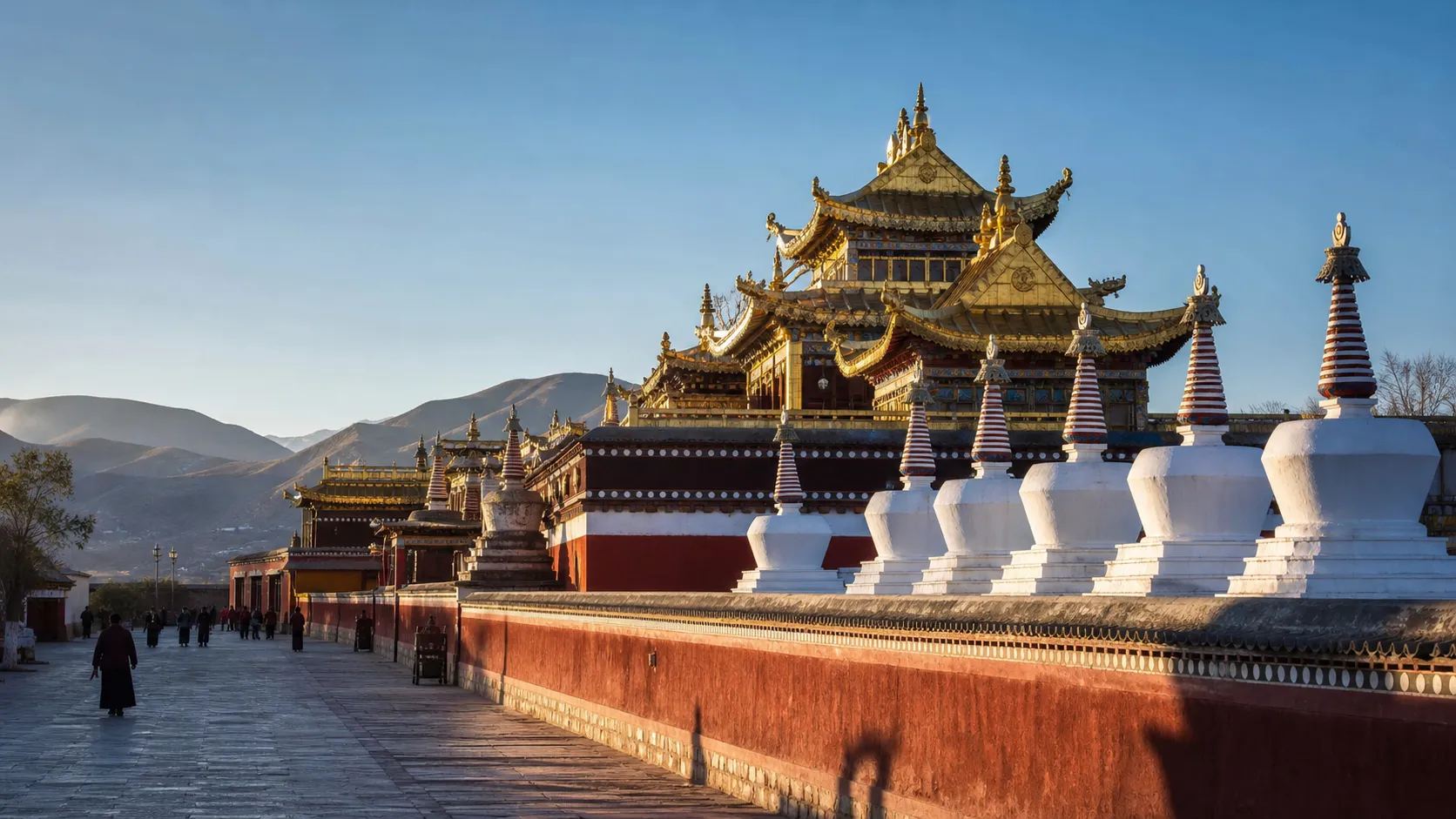
Kumbum Monastery is located in Huangzhong District, approximately 45 minutes from central Xining in Qinghai Province. It is one of the great Gelug monasteries, deeply connected to the legacy of Tsongkhapa, and has drawn pilgrims, scholars, and monks from across the Tibetan world for generations.
For travelers, the experience at Kumbum operates on several levels simultaneously.
Architecture and Sacred Space
The monastery complex encompasses multiple halls and pavilions that blend Tibetan, Han Chinese, and Mongolian architectural styles into a cohesive whole. Golden rooftops rise above whitewashed walls; butter lamp flames flicker inside halls thick with incense; the proportions and orientations of buildings follow precise spiritual logic. Simply moving through the space — from courtyard to hall, from sunlight into shadow — creates an experience of atmosphere that no photograph can fully replicate.
The Three Artistic Wonders
Kumbum is celebrated throughout the Tibetan Buddhist world for three distinctive art forms collectively known as the "Three Wonders" (三絕): butter sculpture, murals, and appliqué embroidery (堆繡).Butter sculpture — intricate figures, scenes from Buddhist teachings, and natural motifs shaped entirely from colored yak butter — represents one of the most unusual and demanding art forms in existence, produced by monks who train for years to develop the necessary precision. The monastery's murals, covering vast surfaces within the main halls, depict Buddhist figures, cosmological diagrams, and historical scenes in a visual language accumulated over hundreds of years. And the appliqué embroidery, created from silk, satin, and brocade in vivid relief, produces three-dimensional compositions of remarkable delicacy and color.
A Living Tradition
Perhaps the most significant quality of Kumbum Monastery is that it is not a museum. Monastic life continues here. Monks study, debate, and carry out ritual practice within the same spaces open to visitors. Pilgrims arrive from distant regions to circumambulate the halls and offer prayers. The sound, the movement, the smell of incense and butter lamps — these are not recreated for visitors. They are simply what life here looks like.On our itinerary, guests visit Kumbum Monastery with a dedicated private guide and VIP transport, ensuring that the experience is not one of navigating crowds, but of moving through the monastery with context, curiosity, and the space to genuinely absorb what you are seeing.
Setting the Stage: Kumbum Monastery as Cultural Prologue
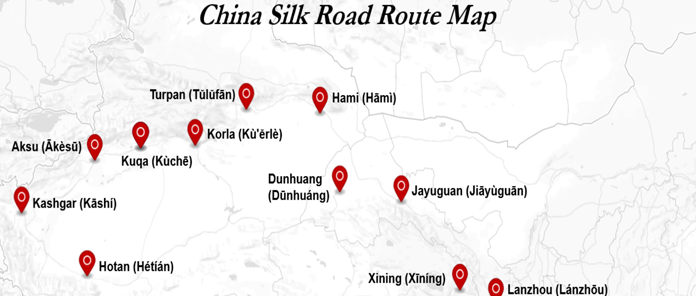
On our Xining–Dunhuang 5-Day rail journey with Glamour Trains, Kumbum Monastery is visited on the morning of Day Two. After arriving in Xining the previous afternoon and settling into the Wanda Reign hotel, guests depart for the monastery by private car, spend the morning in guided exploration, and return to board the train westward in the afternoon.
This sequence is deliberate. Before travelers encounter the Mogao Caves at Dunhuang — one of the greatest repositories of Buddhist art in the world — they will have already stood inside a living Tibetan Buddhist monastery, seen its art in its natural context, and gained a working sense of the tradition that shaped so much of what those cave murals represent. The experience at Kumbum does not stand alone; it opens a conversation that the rest of the journey continues.
For guests who prefer to spend the morning differently, the itinerary offers an alternative visit to the Tibetan Culture Museum in Xining, home to a 618-meter thangka scroll — the longest in China — which approaches the same cultural world from a more curatorial, art-historical perspective.
Either path provides what travel at its best always provides: not just sights, but a way of seeing.
A Place to Begin
Tibetan Buddhism is a tradition that rewards patience and curiosity. It is not necessary to understand everything at once, and a single monastery visit will not answer every question. But it can do something more valuable: it can make you want to look more carefully, ask better questions, and approach the landscapes, histories, and art forms ahead with a more engaged eye.
From the golden rooftops of Kumbum Monastery in Xining to the thousand-year-old murals of Dunhuang, to the ancient Silk Road cities of the Hexi Corridor — what seems at first like a series of separate destinations gradually reveals itself as chapters in a single, unfolding story. Kumbum is where that story, for many travelers, begins to come into focus.