




Tibetan Fox: Why Does This Square-Faced Hunter Look So Unusual?
Of all the foxes in the world, the Tibetan fox may be the hardest to forget. Its face looks like someone pressed the sides inward and forgot to let go — wide, square, almost sculptural. Photographs of it routinely go viral online, with viewers describing it as "unbothered," "deadpan," and occasionally "designed by AI."
But the Tibetan fox is not a punchline. It is one of the most perfectly adapted predators on the roof of the world, and once you understand where it lives and what it does, the face starts to make a different kind of sense altogether.
What Is a Tibetan Fox?
The Tibetan fox (Vulpes ferrilata), also known as the Tibetan sand fox, is a species of true fox endemic to the high-altitude regions of the Qinghai-Tibetan Plateau. It is found across western China — including the provinces of Qinghai, Gansu, Sichuan, Xinjiang, and Yunnan — as well as parts of Nepal, India, and Bhutan.
It is not the largest fox, and it is not the rarest. According to the IUCN Red List of Threatened Species, the Tibetan fox is currently listed as Least Concern, owing to its relatively stable and widespread distribution across the Qinghai-Tibetan Plateau's steppes and semi-deserts. What makes it unusual is not its conservation status but its appearance, its altitude, and the way it hunts.
Why Does the Tibetan Fox Look So Different?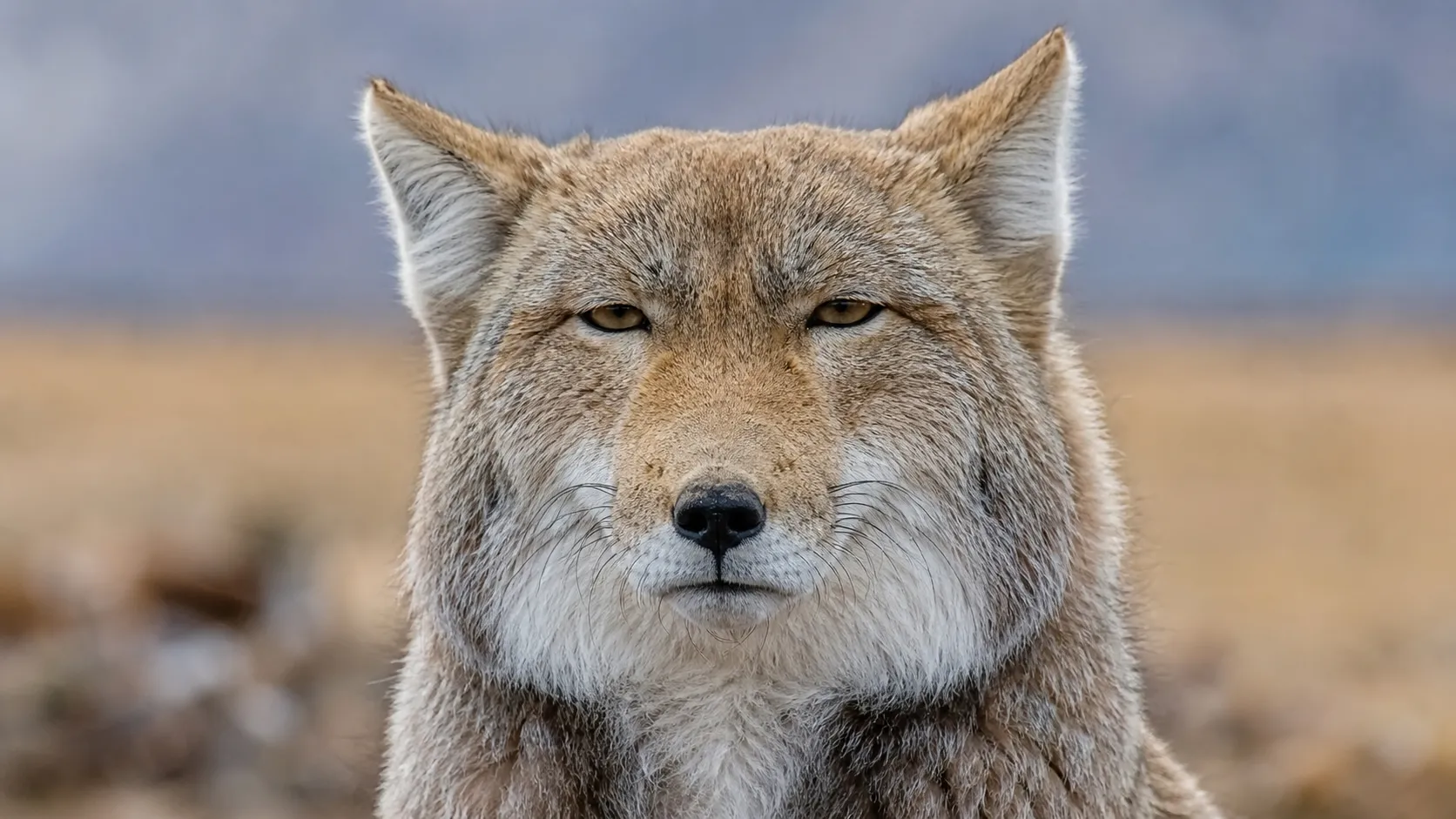
Most foxes have a pointed, tapered muzzle — aerodynamic, expressive, built for speed and agility. The Tibetan fox has something closer to a rectangular block.
The key feature is its broad, square skull and heavily developed jaw muscles, which give it that distinctive wide-faced appearance. Its eyes are small and narrowly set, and its muzzle is relatively short. Its fur is dense and thick, ranging from tawny and rust-colored across the back to white or pale on the belly and tail.
This is not a cosmetic quirk. In the high, cold, windswept grasslands of the Qinghai-Tibetan Plateau, where temperatures can plunge and prey is mobile and difficult to catch, jaw strength matters. The Tibetan fox's build is calibrated for power, endurance, and cold-weather survival rather than elegance.
Its stoic, expressionless face — the one that makes for such compelling photographs — is largely a function of that same musculature. The broad jaw muscles fill out the face and leave little room for the kind of mobile, expressive features we associate with more familiar foxes.
Where Does the Tibetan Fox Live?
The Tibetan fox is, genuinely, a creature of extreme altitude. It inhabits upland plains, rocky slopes, and semi-arid grasslands at elevations typically between 3,500 and 5,300 metres above sea level, though occasional sightings have been recorded as low as 2,500 metres.
Its range extends across the Qinghai-Tibetan Plateau in China — particularly through Qinghai, Tibet, and Sichuan — and into the high-altitude regions of northwestern India such as Ladakh, as well as the Mustang district of Nepal.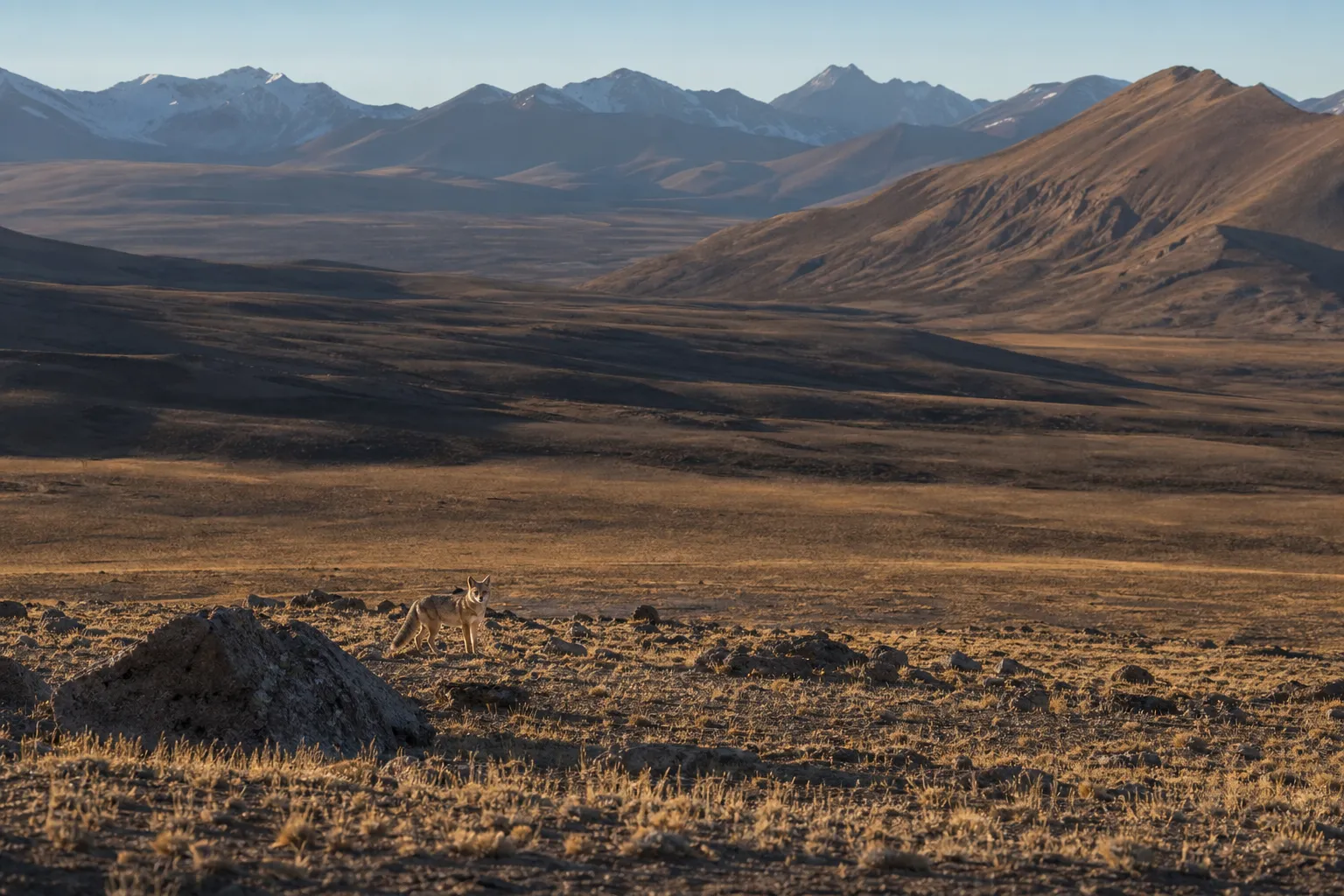
The landscape it prefers is open, windswept, and sparsely vegetated: high steppe, semi-desert, and barren hillsides. It typically avoids dense vegetation and areas heavily populated by humans. It lives in excavated dens or burrows under rocks and boulders, where pairs will shelter together and raise their young.
What Does the Tibetan Fox Eat?
Here is where the Tibetan fox becomes genuinely fascinating as an ecological subject, not just a visual one.
Its primary prey is the plateau pika (Ochotona curzoniae) — a small, round, rabbit-like mammal that lives in large colonies across the Tibetan grasslands. The distribution of Tibetan foxes across the plateau closely mirrors the distribution of pikas. Where pikas are abundant, foxes tend to follow.
Beyond pikas, Tibetan foxes also hunt rodents, hares, small ground birds, and lizards — essentially anything catchable at altitude. They hunt in mated pairs, with male and female sharing both the hunting work and the responsibility of raising kits.
One of the most remarkable feeding behaviors documented on the Qinghai-Tibetan Plateau involves the fox's relationship with brown bears. Tibetan foxes have been observed following brown bears as the bears dig out pikas from frozen ground, then seizing the pikas that escape at the other end of the burrow. It is a rare example of interspecies opportunism: the fox provides nothing and risks little, while the bear does the hard excavation work. As described in detail by the Smithsonian's National Zoo,this kind of behavioral flexibility is a hallmark of successful high-altitude predators.
How Does It Survive at These Altitudes?
The Qinghai-Tibetan Plateau is one of the most demanding environments on earth for any mammal — cold, oxygen-thin, seasonally harsh, and with prey that is patchily distributed across vast open terrain.
The Tibetan fox is built for it. Its dense double-layered coat provides insulation against extreme cold. Its low-key coloration — tawny and earth-toned — allows it to move through open grassland with minimal visual exposure. Its strong jaw and compact body reduce energy expenditure during hunting.
It is also a committed monogamist. Mated pairs stay together for life, sharing territory, hunting, and parental duties. During pup-rearing season, the male hunts almost continuously to feed the family. This pair-bonded structure is unusual among foxes and is likely an adaptation to the scarcity of resources at high altitude — where a single animal hunting alone would be less efficient than two covering overlapping ground together.
Why the Tibetan Fox Is More Than a Meme
It is worth being honest: a significant portion of people who look up "Tibetan fox" online are drawn by the face. The square jaw, the small eyes, the look of absolute indifference — it is undeniably arresting, and social media has made the most of it.
But the Tibetan fox is more interesting than its expression. It is a keystone predator in the plateau pika ecosystem, meaning its presence helps regulate pika populations that would otherwise overcrowd and degrade grassland habitats. According to Tibetan Fox - SAFE Worldwide, the Tibetan fox is listed as a second-class nationally protected animal in China specifically because of this ecological role — even though it is not currently endangered.
It is also a useful lens for understanding the Qinghai-Tibetan Plateau as a whole. An ecosystem where foxes follow bears, where pika colonies determine predator distribution, and where animals have evolved square faces and monogamous partnerships in response to thin air and hard winters — this is not ordinary wildlife. It is a portrait of high-altitude adaptation at its most refined.
As noted in the Tibetan Sand Fox: High-Altitude Hunter, the Tibetan sand fox represents exactly the kind of species that rewards closer attention: easy to overlook at first, extraordinary once understood.
Where Families Can Learn About Plateau Wildlife
For families traveling through Xining and the Qinghai-Tibetan Plateau region, the Tibetan fox offers a natural entry point into understanding high-altitude ecology — not as an abstract subject, but as something with a face, a hunting strategy, and a specific landscape it belongs to.
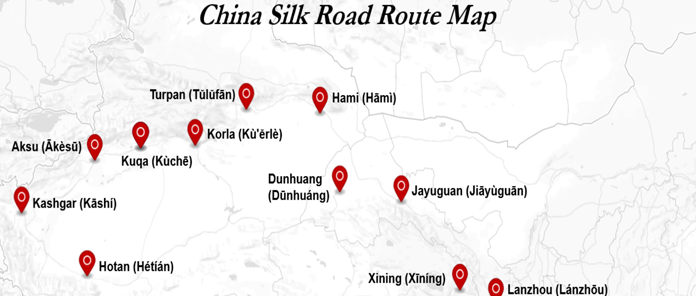
On the Xining–Dunhuang Silk Road Express journey operated by Silk Road Express, family-friendly activities include a guided educational experience focused on native plateau wildlife and natural ecosystems, where species like these are placed in their broader ecological context by expert guides. It is a very different kind of nature encounter than a standard zoo visit — and for children who already know the fox's face from a screen, meeting the story behind it tends to make the plateau itself far more memorable.